
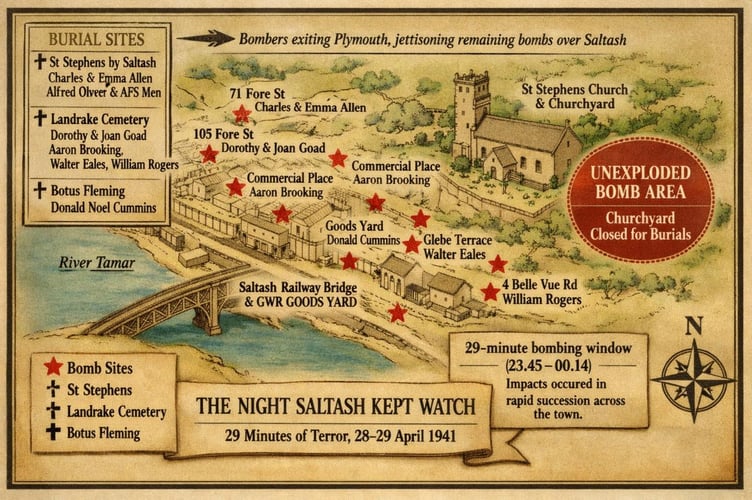
SALTASH is today remembering one of the darkest nights in its history – the evening 85 years ago when the town came under attack as Plymouth burned across the water.
On the night of April 28, 1941, residents watched from doorways in Fore Street and St Stephen’s Road as the sky over Devonport glowed orange from fierce bombing raids. They heard the thud of explosions and the crash of collapsing buildings. Then the war came to Saltash itself.
As enemy aircraft turned west after bombing Plymouth, they released their remaining bombs over the Tamar to lighten their load. Those bombs fell on Saltash.
Plymouth’s air raid sirens sounded at 9.45pm. By 10.10pm Saltash’s own warning followed, sending families rushing to Anderson shelters, cellars and public shelters off Fore Street.
Then, in a devastating 25-minute spell, tragedy struck street after street.
At 11.45pm, a bomb near 71 Fore Street killed Charles and Emma Allen in their home. Two minutes later, another blast near 105 Fore Street killed Dorothy Goad and her daughter Joan.
At 11.50pm, a bomb behind Fore Street at Commercial Place killed Aaron Brooking. Minutes later, Saltash Station’s GWR goods yard was hit, claiming the life of 18-year-old Donald Noel Cummins, a Scout and Auxiliary Fire Service volunteer on duty that night.
Further bombs killed Walter Eales at Glebe Terrace and William Rogers at Belle Vue Road.
The all-clear sounded at 12.10am, but the toll continued to rise. ARP Warden Alfred William Olver, injured in Fore Street, later died at St Barnabas Hospital.
Nine Saltash civilians were killed in those few minutes – just six days after the town had already lost six Auxiliary Fire Service men in the King Street explosion in Devonport.
Because an unexploded bomb lay near St Stephen’s churchyard, victims were first buried at Landrake for safety before some were later reinterred in Saltash. Others remain at Landrake and Botus Fleming.
Today, they are remembered not as names in a record book, but as neighbours who lived in the town’s streets, worked in its shops and worshipped in its churches.
Eighty-five years on, Saltash has not forgotten.
Comments
This article has no comments yet. Be the first to leave a comment.