
EACH week, hundreds of planning applications come before Cornwall Council’s planning department, seeking to win approval for various plans right across the Duchy.
These plans can comprise of a number of different reasonings – ranging from permission to replace windows or listed building consent ranging up to large house building developments or changing of use of a building, for instance, from an office to a café, or flats.
Within this large and often complex system, there are a number of formats from which planning advice and approval can be sought.
These range from full applications where all the details which comprise a proposed development or work to a building are submitted, to outline applications, where further details are yet to be confirmed, for example, an outline application with reserved matters for appearance may not confirm the final proposed development but rather seek permission in principle.




An example of this is one for an outline permission for 20 dwellings on land with reserved matters for appearance and scale; the reserved matters would require further permission later for their inclusion.
Other types of applications include pre-application advice requests, where would-be developers submit often outline proposals to a local authority to ascertain whether it is likely to gain support or not prior to submitting a planning application.
The vast majority of applications are decided by planning officers employed by a local authority under ‘delegated powers’, meaning they do so on behalf of their employer, however, some applications are ‘called in’ by local councillors to be discussed at an area’s strategic planning committee meeting, meaning the final decision rests with a committee of councillors.
Footbridge over A38
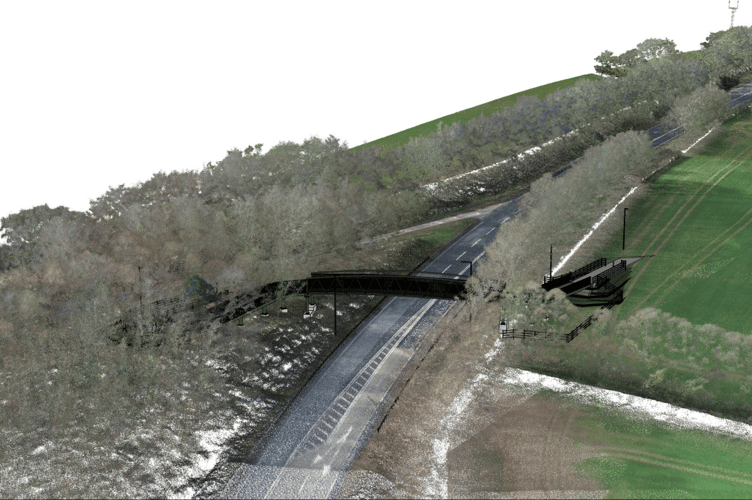
DETAILED plans to finalise proposals for the construction of a new pedestrian and cycle bridge over the A38 to help facilitate an urban extension in Saltash have been approved to Cornwall Council.
Bloor Homes Ltd submitted a reserved matters application, which relates to appearance, landscaping, layout and scale for the construction of a new footway and cycle way, to incorporate a new bridge for pedestrians and cyclists over the A38.
It would link the Treledan Urban Extension with Liskeard Road and associated development with the reserved matters application of which outline approval was given in 2017.
The applicant told Cornwall Council: “The proposed footbridge is to form part of the improvements of infrastructure associated with the Treledan development to the north of the A38 with the objective to promote sustainable transport to nearby Saltash and encouraging the modal shift from cars to walking and cycling. The bridge over the A38 is to be on the new route for a shared use path for the benefit of cyclists and pedestrians. The route extending from the new development to the north, through a “strategic open green space”, over the proposed bridge across the A38, through a small wooded area, before crossing the B3271 (on-slip for the A38).
“The shared use path then follows the south verge of the B3271 to Latchbrook Roundabout where it will enable cyclists and pedestrians to join the existing network of carriageways, cycle lanes and footpaths linking to various locations of Saltash.
“Current plans show the detailed proposed route to Latchbrook Roundabout extending to the south beyond the boundary line of the development as per the outline permission.
“This application is for the implementation of the shared use path up to the edge of the boundary line with the section further south to be developed by the Local Highway Authority. The proposed bridge will also allow safe crossing of the A38 for pedestrians and walkers willing to reach the Latchbrook Valley and its network of footpath and bridleways from the new development.
“The proposed bridge is to be located where the A38 appears to be in a cutting to minimise the height of the structure above ground, reduce the length of the approach ramps and therefore minimise the visual impact of the structure.
“The proposed structure is to consist of a main single span (31.185m) across the A38 connected to multi-span elevated approach ramps to both the north (22.554m long) and the south (31.566m long) leading to a ground bearing path at both ends.
“The approach ramps rise at a gradient no greater than 1 in 20 to meet the main span which of the soffit is slightly arched to provide suitable headroom over the A38 and to facilitate drainage.”
Approval was given by Cornwall Council.
The conditions attached to the approval stipulated a number of things that the applicant must abide by.
One condition related to the protection of trees in the area, with all trees shown in the arboricultural plan to remain intact and undamaged during the works, with all soils retained and protected within the root protection area. If any become damaged, a mitigation plan must be filed to Cornwall Council.
The planning authority said that this condition was in the interests of maintaining a tree cover within the local landscape.
Another condition related to the scheme being carried out in accordance with the submitted environmental and ecological appraisals and plans.
Cornwall Council said that this condition was in the interests of managing habitats, ecology and the local environment.
The third condition was that the development must be completed in accordance with the submitted landscape and ecological management plan in order to manage the impact of the development on the local environment.
Objections overruled
AN application seeking to establish a permission in principle for the construction of a dwelling near to a commonly flooded area of Bodmin has been approved despite the concerns of residents.
It concerned land to the North West of Flaxmoor Terrace in Bodmin, a residential area next to Bodmin Jail that has often been associated with flooding over the years – to the point where the area has historically been called ‘Watery Lane’ locally.
The permission in principle (PiP) consent route is an alternative way of obtaining planning permission for housing-led development which separates the consideration of matters of principle for proposed development from the technical detail of the development.
It is a consent route which has two stages: the first stage (or PiP stage) establishes whether a site is suitable in principle and the second, known as the technical details consent stage is when the detailed development proposals are assessed.
While a permission in principle has been granted, a full planning permission through the granting of a technical details consent will be required for it to be permitted – and it is at this point where there would be a full assessment of the proposals.
Giving approval to the application, Cornwall Council’s planners concluded: “It is considered that the principle of the development of this land for the construction of a single dwelling is acceptable in accordance with the aims and intentions of policies 1, 2, 3 and 21 of the Cornwall Local Plan. However, the site must receive a grant of technical details consent before the development can proceed.
Find out about planning applications that affect you by visiting the Public Notice Portal.
“The granting of technical details consent has the effect of granting planning permission for the development. Technical details consent can be obtained following submission of a valid application to the local planning authority. An application for technical details consent must be in accordance with the approved details specified within the said 'Permission in Principle'.”
Comments
We've recently changed our login process. If you have an account for commenting, you will need to re-register on the login window.
This article has no comments yet. Be the first to leave a comment.