
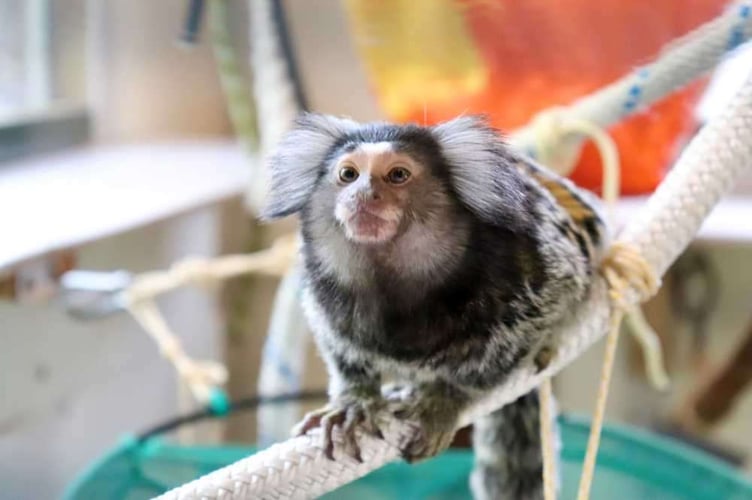
A CORNISH primate sanctuary has raised the alarm over a lack of action from private primate owners ahead of new UK welfare laws, warning that thousands of monkeys and marmosets could be living in unsafe conditions.
Sarah Hanson, director of Wild Futures in Looe, said: “Wild Futures wants to see a total end to the UK primate pet trade. Primates are intelligent, socially complex, wild animals, inherently unsuitable for keeping in a domestic setting. We see first-hand the devastating effect that being kept as a pet has on primates.
“Some 87 per cent of our rescued marmosets never had outdoor access, and many of our rescued monkeys were fed inappropriate diets including sweets and chocolate, causing some of them to develop diseases such as diabetes.
“As long as there is a UK primate pet trade and private ownership, there will be primates kept in inappropriate conditions, with welfare severely compromised. The new regulations are not the ban that many of us have been calling for.

.png?width=209&height=140&crop=209:145,smart&quality=75)


“We were hopeful that, if enforced correctly and supported by sufficiently rigorous guidance, the new regulations could have a meaningful and positive impact on primate welfare and be a step towards our goal of ending private ownership of primates in the UK.”
The Animal Welfare (Primate Licences, England) Regulations 2024, coming into force on April 6, require all private keepers to hold a licence or face fines and potentially jail. Yet research by wildlife charity Born Free shows only three licence applications have been submitted so far. Government estimates suggest between 3,000 and 5,000 primates are privately kept in the UK, but most owners have not applied.
Chris Lewis, Born Free’s research and policy manager, said: “Nobody knows exactly how many primates are kept in private homes because there has never been a registration or licensing system before. These regulations cover everything from chimpanzees to common marmosets.
“Most privately kept primates are smaller species such as marmosets or tamarins, often confined to bird or parrot cages. Many owners are aware of the rules but cannot meet them, so continue to keep these primates in secret.”
Ms Hanson said she was “alarmed” by the figures, adding: “Born Free’s data shows a failure of government to raise awareness of the new licence requirements. We join Born Free in urging the government and local authorities to ensure people are made aware, and they remain true to their promise of effective implementation and enforcement so that every privately held primate receives the best possible standards of welfare, which is the least that they deserve.”
Wild Futures, which closed to visitors in 2025 but continues to rescue small primates, recently took in Apollo, a marmoset cross, and Bobby, a common marmoset suffering from metabolic bone disease caused by an improper diet. Hanson said such cases highlight why stronger measures are needed.
The Department for Environment, Food and Rural Affairs stressed primates are “highly intelligent and complex animals” and that private keepers must provide “zoo-level welfare standards.”
Officials are working with local councils to enforce the licensing system.
Comments
This article has no comments yet. Be the first to leave a comment.