
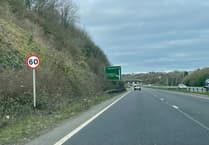
The A38 at Trerulefoot had to be closed to westbound traffic for more than three hours after a cloud of highly-flammable gas blew across the road.
The firefighters were called by the filling station just after noon on Wednesday and the westbound carriageway of the A38 was closed to all vehicles as gas venting from the vehicle was being blown in a plume across the road.
Traffic was diverted at Carkeel by way of Callington, while the eastbound carriageway remained open to all but heavy goods vehicles.


The petrol station was evacuated and the electrics isolated. The crews used one covering jet and one hosereel to disperse the gas plume.
The leak was eventually stopped by a vehicle engineer and when the area was declared safe by firefighters using a gas monitor, the A38 was reopened at about 3pm.
Staff at the filling station said later they understood the leak had developed in a valve controlling the LPG system on the car. The filling station had immediately been closed, staff evacuated and an exclusion zone set up around the area.
The car is believed to have been filling with fuel at the time the leak developed and could not be moved.
Vanessa Guyll, a technical specialist with the AA, told the Cornish Times yesterday that such leaks were very rare and that the AA hardly ever heard of such incidents.
She said: 'It usually happens on garage forecourts when the filler valve doesn't close properly as the nozzle is removed from the tank. We suggest that people replace the filler nozzle and then remove it again to see if the valve closes – if it doesn't, raise the alarm.'
She said that LPG systems were generally designed to pick up any problems and if a massive fuel flow rate was detected they should shut down immediately. The AA stresses the need for proper installation of LPG systems and regular checks to ensure that they are working properly.
Sacha Wheatman, group manager with Cornwall County Fire Brigade, said firefighters had attended five LPG vehicle incidents in the county during the past year.
'But as numbers of LPG vehicles increase this may rise,' she said. 'If you suspect your vehicle is leaking LPG, do not move it, keep away from the vehicle and immediately dial 999 asking for the fire brigade, explaining that your vehicle may be leaking LPG.
'LPG vapour can be extremely flammable and in some cases explosive and LPG systems must not be dealt with by anyone who is not appropriately trained.
'In all the cases we have dealt with so far, we have stopped the flow of LPG and safely dispersed the vapour.
'So dealt with swiftly and correctly these incidents should not end in disaster.'