

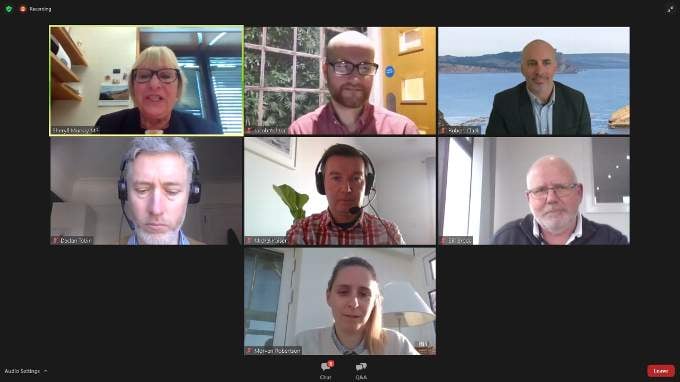
Over 120 attendees tuned in to the APPG on Fisheries’ first event of 2022 including Sheryll Murray, which took place on February 22. Entitled ‘Fisheries and Protected Areas’, participants heard from speakers from across the fisheries and conservation worlds, about how collaboration is key for effective management of Marine Protected Areas (MPAs).
"Making sure that management of Marine Protected Areas is collaborative and inclusive is a key priority for fishermen, policymakers, and conservationists alike,” said Sheryll Murray MP, Chair of the APPG on Fisheries. “It was great to hear such a range of speakers and attendees engage in constructive discussions."
“There’s a lot of nuance around how to deliver management for MPAs around the UK,” said Dr Declan Tobin of the Joint Nature Conservation Committee (JNCC) during the event. He presented on the JNCC’s MPA Fisheries Management Toolkit, completed in 2020, which aims to enable a participatory approach to the management of fishing activity in UK offshore MPAs. “We were trying to get buy-in from all the key stakeholders,” he said. “The idea was to build a sense of stewardship for MPAs, with a shared common goal.”
The next presentation, from Rob Clark of the Association of Inshore Fisheries and Conservation Authorities (AIFCA), focused on how IFCAs have worked to inclusively support fisheries policy and MPA management at the regional level. “The IFCAs undertook assessment of fishing at site level,” he said during the event. “This required both the extensive participation of the fishing industry and others, and engagement with the statutory nature conservation authorities, to identify the location and extent of features within MPAs.”

Morven Robertson of the Blue Marine Foundation (BLUE) presented on how BLUE has engaged fishermen in collaborative management of fisheries within MPAs, and the charity’s upcoming guide to MPA establishment and management. “Fishermen must be involved in the management and research of protected areas,” she said. “It’s really important to find common areas of interest to tie everyone together.”
Professor Michel Kaiser of Heriot-Watt University spoke on the importance of empowering the fishing industry to take charge of sustainable management. “What we find is that when we give fishermen rights and ownership, and hence responsibility and involvement in management of fisheries, we see considerable improvements in fishing efficiency, quality of the marine environment, efficiencies in terms of CO2 emission reductions, and greater increases in profitability,” he said.
Fishing vessel operator and fish merchant Bill Brock concluded presentations, speaking on how to optimise interactions between the fishing industry and protected area designation and management. “With the creation of a logical and clear link between protection of a finite feature, and benefit to the fishermen, you will have a long-term and easy-to-enforce policy that assists both the marine environment and the fishing industry alike,” he said, but cautioned that to date he felt that MPA designation and fishing industry involvement had been far from perfect.
Presentations were followed by questions and discussion points from the audience, on themes ranging from linking fisheries product marketing to MPAs, to scope for co-creation of knowledge and the co-management of MPAs. A summary of the Q&A and the event recording are both available on the APPG website. The APPG Secretariat will also publish a policy brief detailing the outputs and key messages for the event in the coming weeks. Sign up to their newsletter to be the first to access APPG resources and hear about upcoming events.