

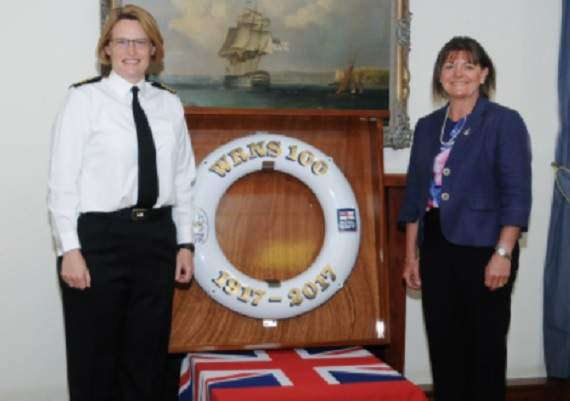
Former members of the Women’s Royal Naval Service (WRNS) will be back on parade at HMS Raleigh today to mark the 100th anniversary of the formation of the service.
In total 50 blue-badge WRNS have accepted the invitation to spend the day at the establishment for a trip down memory lane and the chance to meet the men and women who serve in the Royal Navy today.
A group of 17 has opted to take part in the passing-out-parade, while the others will join families and friends in the stands.
HMS Raleigh was the home of initial naval training for WRNS from 1981 until training for men and women was amalgamated in 1990.
.png?width=209&height=140&crop=209:145,smart&quality=75)


.jpeg?width=209&height=140&crop=209:145,smart&quality=75)
Training had transferred from HMS Dauntless, near Reading.
The Navy News reported at the time that the first 50 Wrens, as they were affectionately known, to report to Raleigh for training were greeted by the Royal Marines Band playing ‘Hello Dolly’.
Although training for men and women were strictly separate at the time, the WRNS course mirrored that undertaken by the men, minus the assault course.
Additions to the training programme brought about by the move included a swimming test, a Dartmoor expedition with a night under canvas, visits to ships at Devonport Naval Base and use of the boats at Jupiter Point.
Former WRNS Officer Jacqueline Clink joined the service at HMS Raleigh in 1983 on the Cadet Wren scheme. She will lead the WRNS platoon on parade, saluting her husband, Rear Admiral John Clink, Flag Officer Sea Training (FOST), the VIP inspecting officer.
Mrs Clink describes her training as ‘fun days’.
She said: ’I loved the marching and that sense of belonging to the Service on the parade ground. However, marching around the establishment was interesting as I didn’t have contact lens at the time so I couldn’t see who I was meant to be
saluting. So I saluted everyone that walked passed me; Petty Officers to Officers. My other memories include going out on the moors and doing the exercises in what we called our ‘you can’t see me suits’, carrying heavy rucksacks, doing teamwork exercises and just enjoying some time getting stuck in and being in a Military service. It was challenging and rewarding.’
The WRNS was formed in 1917 as the Royal Navy faced a deteriorating manpower situation as a result of the First World War.
During World War Two the competition to join the WRNS was very strong. Again women played their part so that the men could go to sea, but their role increased to include radio operators and even boat crew. The WRNS was permanently established in 1949 and women became an integral part of the Royal Navy.
The WRNS was formally disbanded on November 1, 1993 when 4,535 women transferred fully into the Royal Navy. Their supporting role had come to a proud end.
Capt Ablett, pictured with Mrs Clink, said: ’Today women serve alongside their male colleagues at sea, under the sea and in the air, and soon we will be welcoming the first women hoping to become Royal Marines Commandos.
’We are looking forward to hosting our predecessors who paved the way for full integration and showing them how the service has changed.’
Comments
This article has no comments yet. Be the first to leave a comment.