

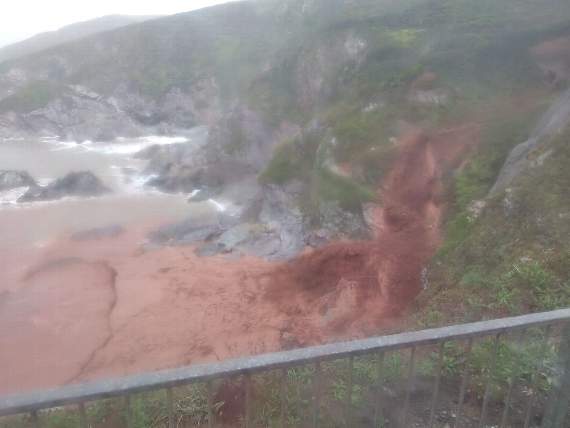
SOIL that entered the sea as a result of a huge mudslide during last week’s extreme rain could have a devastating effect on the seabed in the marine conservation zone, an environmentalist has warned.
Last week’s landslip during Storm Francis cut off access to a beach in Whitsand Bay as torrents of mud and water came off fields and over the cliffside road.
‘Biblical scenes’ unfolded, said Claire Wallerstein of the Rame Peninsula Beach Care Group, as the intense rainfall caused flash flooding and brought ‘untold tons’ of topsoil off a nearby farm.
The road was closed but some vehicles had already become trapped in the mud and had to be towed out.

.jpg?width=209&height=140&crop=209:145,smart&quality=75)
.jpg?width=209&height=140&crop=209:145,smart&quality=75)

Meanwhile, the bridge and steps to Sharrow Beach were badly damaged in the mudslide, cutting off access.
The full potential impact of the loss of topsoil into the sea became evident later, said Claire, when a red plume of sediment in the sea close to the site eventually spread across the whole bay.
“It was tragic to see all this mud – and potentially fertiliser and other chemicals – rushing off the land straight into this protected body of water,” she said.
“Not only is it a loss of our precious topsoil but it could also have serious effects on marine species and seabed ecology.
“We’re still in August and this is the second big storm we’ve had already. All the scientific forecasts show that our weather is going to become wetter and storms more intense as our climate changes, so scenes like this will unfortunately become more and more common.”
The Whitsand and Looe Bay Marine Conservation Zone was designated to protect important species including the pink sea fan coral and the ocean quahog, a bivalve mollusc that can live for up to 400 years.
Fields left bare through the winter on the Rame Peninsula already contributed to a similar event in February, said Claire, when mud from steep-sided maize fields ran off into watercourses and into the sea.
Topsoil and slurry run-off from those events could cause smothering and algae growth, with impacts on the seagrass beds in Cawsand Bay – the very seagrass that plays a role in sequestering carbon and helping to mitigate against climate change. The UK has lost 95% of its seagrass beds in recent decades.
“Farmers obviously work incredibly hard and the last thing they want is to be losing topsoil or crops. And we all need to eat food, ideally much more of it locally grown,” said Claire.
“But there needs to be more focus on what’s being grown, how and where, to help combat the impacts of extreme weather events. The world has lost half of its topsoil in the last 150 years and we need to hold onto it! Not only can it cause potentially serious problems in the marine ecosystem, but once it’s lost we won’t be able to get it back to grow our food.
“There are many sustainable ways of managing land and soil in a regenerative way, for example by using minimal tilling, stopping soil from becoming compacted, planting cover crops and interspersing grazing land with more trees.
“It would also be great to look at other ways of preventing flooding, for example by reintroducing beavers in some places.”