

In his weekly Nature Watch for the Cornish Times, photographer Ray Roberts takes walks close to his home village of Quethiock and further afield in South East Cornwall. With an eagle eye and camera in hand, Ray captures wildlife of interest along the way - and for many years now, he has been sharing these images as well as his extensive knowledge of the local flora and fauna with readers.
We hope you enjoy this week’s Nature Watch, with thanks to Ray Roberts.
There are a couple of green lanes near the village; Darky Lane to the north and Muddy Lane to the west, and they can both be used as part of a circular walk of around a mile, and it saves having to walk on the same stretch of road twice, although both routes have a bit of uphill walking.
In wet weather, though, waterproof boots are needed. Both lanes are frequented by butterflies, and an occasional rabbit can be seen.



.png?width=209&height=140&crop=209:145,smart&quality=75)
I decided to walk through Darky Lane but first had to walk up North Hill, where I noticed a dark clump of what I thought was a smudge of dirt on a large leaf, but on closer examination I could see that it was a crowd of newly-hatched spiders that were each less than 2mm wide.
I photographed them and then touched them with a blade of grass and they dispersed in all directions, but far too many to count.
These youngsters will moult at least three or four times before reaching their full adult size.
Darky Lane is so named as both hedges have tall trees that cut down on the amount of light in the lane.
There were the remains of lots of bluebells, red campions and herb bennet flowers, and several fresh rabbit holes in the hedges that have left piles of earth on the pathway.
I saw a movement on the hedge and there was a young rabbit doing its best to hide behind some ivy leaves – lovely animal to see.
Actually, the name ‘rabbit’ originally applied only to the young animal, an adult was known as a cony.
A lot of the leaves on different geranium plants are turning red due to the past very dry weeks, and herb robert – Geranium robertianum – is one of the first to be affected, but the occasional red leaf can brighten up the hedgerow.
Most of the herb bennet – Geum urbanum – flowers are now showing the round, spiky seed pods that attach themselves to the fur of animals as they walk past, thereby spreading the seeds around the countryside.
There are several clumps of pink flowered doves-foot cranes-bill – Geranium molle – around the hedges.
This plant was well known to early herbalists as a cure for rupture, after crushing up the dried roots and adding it to some oven-roasted slugs. The mixture was then added to claret and drunk. Good luck with that medicine!
Coming down Birch Hill on the way home, I noticed a large wasp-like insect on a leaf and could see that it was in fact a hornet probably 40mm long, but although I usually carry a small tape measure in my pocket, I did not feel inclined to take a precise measurement.
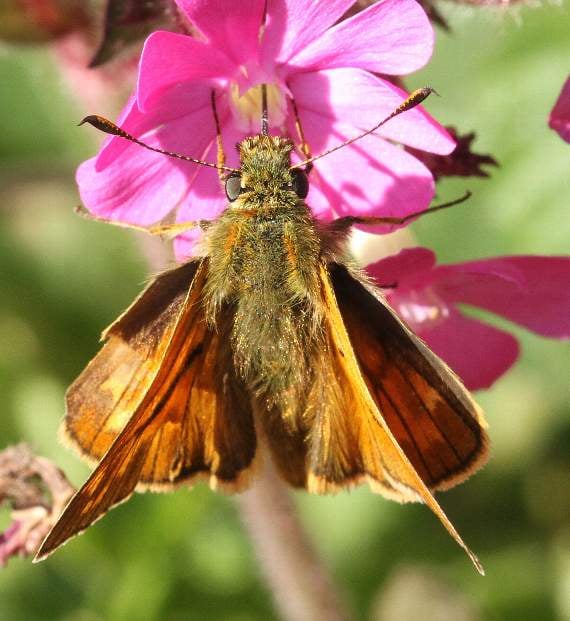
I also saw three large skipper butterflies with distinctive hooks on the ends of their antennae.
They rest their wings in a half-folded position whilst basking in the sun.