
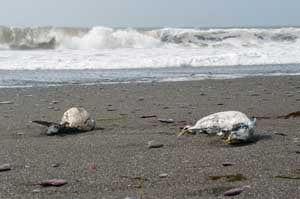
THE sight of hundreds of dead and suffering seabirds being washed ashore along South East Cornwall's coastline has caused shock and anger.
The carnage has been caused by a substance discharged at sea known as PIB (polyisobutylene).
The harm to wildlife has spread beyond birds to other forms of marine life. Yesterday morning, Seaton and Downderry beaches were strewn with hundreds of dead cuttlefish.
Abby Crosby, marine conservation officer for the Cornwall Wildlife Trust, said the cuttlefish deaths were definitely linked to the same PIB pollution incident which has affected the seabirds, and there were reports of other species being harmed, such as dogfish.



'It's tragic. There is a big cuttlefish fishery in this area which is important for local fishermen. This discovery could potentially mean that a whole reproductive generation has been wiped out, just like the seabirds have been.'
In the last week, volunteers from the Rame Peninsula Beach Care Group, Looe Marine Conservation Group, British Divers Marine Life Rescue, Looe monkey sanctuary and local communities have been helping workers from the RSPCA in their task of rescuing as many live birds as possible.
Many of the dead birds were ringed, indicating they had been survivors of a similar pollution incident in January which affected parts of the Westcountry coastline.
The birds include guillemots, gannets, cormorants, gulls and even puffins. They have been washed ashore covered in a sticky white glue-like substance.
At Seaton, one of the worst affected areas, Bonnie Parker, who lives above the beach, said: 'Each day the dead birds are cleared away, but every morning when I look down on to the beach, there seem to be hundreds more.
'They look like a line of white boulders. It's absolutely heartbreaking.'
Hazardous
Cormac workers have been bagging up the dead birds on the beaches each day, while at Looe the task has fallen to the staff of East Looe Town Trust.
Local volunteers have joined other Cornish conservation groups in calling for an urgent change in the law to make the discharging of PIB into the sea illegal.
Currently, the chemical, although known to be hazardous to the marine environment, can be discharged directly into the sea from 12 miles offshore.
Comments
This article has no comments yet. Be the first to leave a comment.