

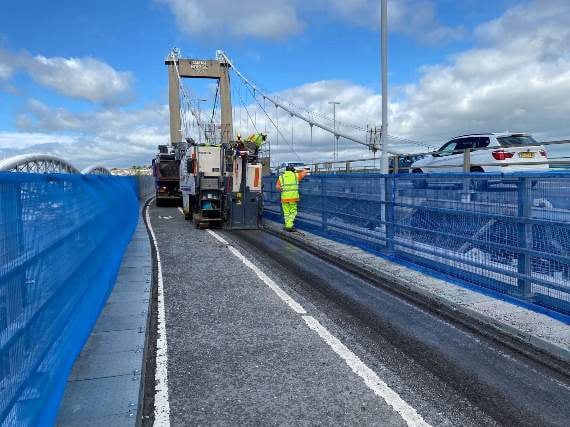
CONTRACTORS are working seven days a week to try and gain back time on the Tamar Bridge resurfacing project – and bridge managers are responding to traffic flows with up to 45 lane swaps a day.
The Cornish Times has previously reported how retailers in Saltash were especially bearing the brunt of delays and congestion caused by the bridge works, and how motorists in both directions were being affected.
The first meeting of the newly-formed Tamar Bridge and Torpoint Ferry committee took questions about the resurfacing project and these were answered by Bridge managers and staff. Town Councillor Steve Miller asked why the plan to keep one cantilever open at certain times had changed, and described the chaos that had ensued, as he saw it, as a result.
He asked whether the impact of the works on traders and the public had been assessed.

.jpg?width=209&height=140&crop=209:145,smart&quality=75)


General manager David List explained that the tender that had gone out stated that “a minimum of three lanes had to be kept open” at any one time. If the possibility were there to have one cantilever open at certain times, it would be used, but that in discussion with the contractor, the contractor had felt it would be better to have both closed, and that the Bridge management team agreed with this, as it would shave eight weeks off the delivery time.
Sarah Martin, who is a town councillor, asked her questions in her capacity as chairman of Saltash Chamber of Commerce. She wanted to know if, given the degree of disruption to the town and its retailers, the committee would consider a public meeting, and Councillor Armand Toms of Looe agreed.
“Saltash has bucked the trend and has more shops open now than before the pandemic started,” said Mrs Martin.
“We are really anxious, having been through lockdowns, about keeping these retailers on Fore Street. I think they would much appreciate a public meeting.”
Mrs Martin said that the traffic flow in Saltash had seemed much better that day, and asked “what the bridge management had done differently”. This was echoed by Councillor Martin Worth, who said he’d allowed for an hour to get across the bridge and it had taken him ten minutes.
However, Callington’s Cllr Andrew Long said that he used the bridge most days during the week and that his journey time was still an hour in the morning and an hour and a quarter at night, and felt that for commuters with no choice on when they travel, the delays were still there.
David List said that at the start of any major project the first two or three weeks were always the worst, and then things would ease up as drivers modified their behaviour.
Mark Meredith of Tamar Crossings said: “As people become experienced and understand how to best get through the system, and as the days have progressed, the flows, particularly through Saltash, have eased.
“I think a lot of people are now going via the Carkeel roundabout and using the A38 and we’ve put further signs up to encourage that.”
Under normal circumstances, the tidal flow arrangements are changed eight to ten times a day, but since the Bridge work began, this has risen to anywhere between 25-45 times a day, which is helping to manage flow, said the staff.
Cllr Worth asked if anything was being done to recover the six weeks lost at the start of the project as contractors’ staff experienced visa issues.
The scheduled finish date was now October 21, said Mr List, and any potential gain would be very much dependent on the weather.
Engineering manager Richard Cole said that contractors are now working weekends and in the evenings. In response to a question from Cllr Long as to whether 24 hour working might be considered during this “once-in-a-generation” project, Plymouth Councillor Pat Patel, who lives in St Budeaux, described the noise emanating from the deck as horrendous and said that night-time working would do more harm than good in terms of PR. Mr Cole added that there were strict regulations when it came to noise levels at night and that environmental health would not be keen on 24-hour working, and the impact that it would have on residents directly under the bridge.
Cllr Long asked whether the planning of the work had taken into account the lifting of the lockdown and the restrictions on international travel that would lead to more staycations and therefore more visitor traffic this summer. He also wondered whether the timing of the works had been discussed in conjunction with the local authorities and Highways England, as there had also been roadworks on bridges further north on the Tamar and that there was a knock-on effect, for example for the A390 in Gunnislake.
Mr List said that any programme of work was determined in consultation with other bodies but there had effectively been no choice about when to carry out the bridge resurfacing work as it required dry, mild weather to complete the project successfully.
Cllr Long and others also asked about the arrangements for breakdowns and accidents, and Mr List explained that while the bridge has its own light recovery vehicle, recoveries on the A38 were separate.
Cllr Toms suggested that tolls be lifted when there is an accident to allow freer flow of traffic off the bridge but Mr List replied that he didn’t feel this would expedite matters.
However, Callington’s Cllr Andrew Long said that he used the bridge most days during the week and that his journey time was still an hour in the morning and an hour and a quarter at night, and felt that for commuters with no choice on when they travel, the delays were still there.
David List said that at the start of any major project the first two or three weeks were always the worst, and then things would ease up as drivers modified their behaviour.
Mark Meredith of Tamar Crossings said: “As people become experienced and understand how to best get through the system, and as the days have progressed, the flows, particularly through Saltash, have eased.
“I think a lot of people are now going via the Carkeel roundabout and using the A38 and we’ve put further signs up to encourage that.”
Under normal circumstances, the tidal flow arrangements are changed eight to ten times a day, but since the Bridge work began, this has risen to anywhere between 25-45 times a day, which is helping to manage flow, said the staff.
Cllr Worth asked if anything was being done to recover the six weeks lost at the start of the project as contractors’ staff experienced visa issues.
The scheduled finish date was now October 21, said Mr List, and any potential gain would be very much dependent on the weather.
Engineering manager Richard Cole said that contractors are now working weekends and in the evenings. In response to a question from Cllr Long as to whether 24 hour working might be considered during this “once-in-a-generation” project, Plymouth Councillor Pat Patel, who lives in St Budeaux, described the noise emanating from the deck as horrendous and said that night-time working would do more harm than good in terms of PR. Mr Cole added that there were strict regulations when it came to noise levels at night and that environmental health would not be keen on 24-hour working, and the impact that it would have on residents directly under the bridge.
Cllr Long asked whether the planning of the work had taken into account the lifting of the lockdown and the restrictions on international travel that would lead to more staycations and therefore more visitor traffic this summer. He also wondered whether the timing of the works had been discussed in conjunction with the local authorities and Highways England, as there had also been roadworks on bridges further north on the Tamar and that there was a knock-on effect, for example for the A390 in Gunnislake.
Mr List said that any programme of work was determined in consultation with other bodies but there had effectively been no choice about when to carry out the bridge resurfacing work as it required dry, mild weather to complete the project successfully.
Cllr Long and others also asked about the arrangements for breakdowns and accidents, and Mr List explained that while the bridge has its own light recovery vehicle, recoveries on the A38 were separate.
Cllr Toms suggested that tolls be lifted when there is an accident to allow freer flow of traffic off the bridge but Mr List replied that he didn’t feel this would expedite matters.