
EACH week, hundreds of planning applications come before Cornwall Council’s planning department, seeking to win approval for various plans right across the Duchy.
These plans can comprise of a number of different reasonings– ranging from permission to replace windows or listed building consent ranging up to large house building developments or changing of use of a building, for instance, from an office to a café, or flats.
Within this large and often complex system, there are a number of formats from which planning advice and approval can be sought.
These range from full applications where all the details which comprise a proposed development or work to a building are submitted, to outline applications, where further details are yet to be confirmed, for example, an outline application with reserved matters for appearance may not confirm the final proposed development but rather seek permission in principle.

.jpeg?width=209&height=140&crop=209:145,smart&quality=75)


An example of this is one for an outline permission for 20 dwellings on land with reserved matters for appearance and scale; the reserved matters would require further permission later for their inclusion.
Other types of applications include pre-application advice requests, where would-be developers submit often outline proposals to a local authority to ascertain whether it is likely to gain support or not prior to submitting a planning application.
The vast majority of applications are decided by planning officers employed by a local authority under ‘delegated powers’, meaning they do so on behalf of their employer, however, some applications are ‘called in’ by local councillors to be discussed at an area’s strategic planning committee meeting, meaning the final decision rests with a committee of councillors.
Extension to holiday park
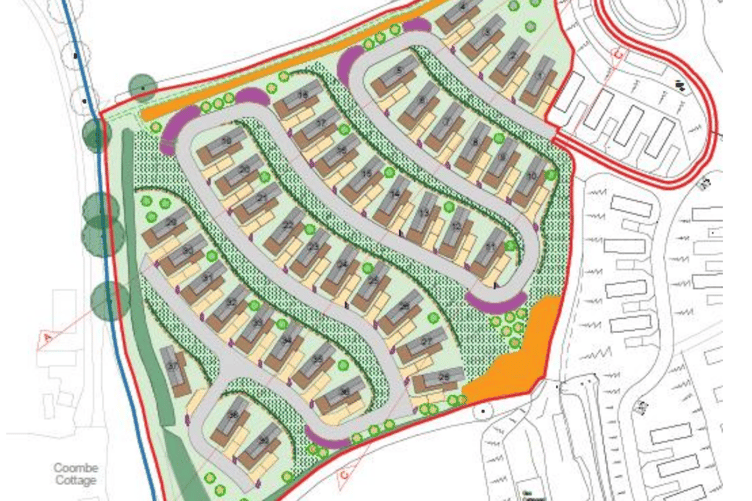
A PLANNING application seeking the extension to an existing holiday park and the provision of 39 lodges, together with associated works and landscaping in Looe has been submitted to Cornwall Council.
The application concerns Tregoad Caravan and Camping Park, in St Martin, Looe.
The applicant, Tregoad Holiday Park Ltd, told Cornwall Council through its planning agent: “Tregoad Holiday Park is flourishing under new ownership. The Applicant is continuing to make a substantial investment into the holiday park taking into consideration the established planning consents.
“The applicant’s investment programme is now well under way, which will be of significant benefit to the local economy, not only in terms of the existing employees, but also with regard to the wider community, including local contractors and suppliers during the construction phases and related economic growth in the local area as the tourism offer at the holiday park is improved.
“In order to continue this investment, the applicant has carried out extensive investigations with regard to the works necessary to implement the approved development, referenced as associated development in the most recent consents. These infrastructure works include upgrading the electricity supply and connections to and throughout the holiday park, and improvements to drainage and water supply.
“The new owners’ desire to provide high quality amenity provision and facilities for its guests continues via the recent planning consent for the installation of a new all-weather swimming pool, in addition to a new facilities building. The result will be a substantial net improvement to the holiday park, improving the offer to tourists with a wider benefit to the local economy as a corollary.
“This application seeks consent to extend the holiday park into an area of under-utilised land under the same ownership, adjoining the existing holiday park. The proposed pitches match the scope and specification of the existing approved pitches.’
The full proposals can be viewed using reference PA26/02218 on the Cornwall Council planning portal. It is set to be decided at a later date.
Cornwall Council hails government figures
Cornwall Council is one of the top five authorities in England for planning enforcement, according to new figures.
The latest information released by the government shows the council’s planning enforcement team served 90 enforcement notices in 2024 / 2025 -ranking it fifth out of 309 councils nationally for the most notices served, up one place from sixth in 2023/2024. Just 18 of the notices went to appeal, with 17 then upheld - a 94 per cent success rate which is above the national average.
Over the same period the council successfully negotiated solutions in a further 335 cases, resulting in planning breaches being addressed without the need for formal enforcement action.
This is the first time the council has been in the top five local planning authorities for serving enforcement notices and demonstrates the authority’s commitment to protecting the environment and conservation areas and making sure that people who breach planning laws are being held to account.
“We know Cornwall is a precious place for the people who live here and the people who visit “, said Cornwall Councillor Sarah Preece, portfolio holder for planning. “We take our responsibility to protect our environment very seriously and will always work with developers to make sure we get the right building in the right place.
“However, in cases where there has been inappropriate development that would not get planning permission or buildings which have not been constructed in accordance with planning permission and which create significant planning harm, we will not hesitate to take enforcement action”.
The council’s planning service normally receives around 10,000 applications a year. The vast majority of these applications progress through the planning system without any issues. In a small number of cases, however, the authority will receive a complaint about something being done without the proper permissions in place or which breaches existing conditions.
The team investigates around 1,300 planning and enforcement cases a year. While some of these will relate to large developments, many will involve smaller issues relating to unauthorised development in conservation areas or inappropriate work carried out to listed buildings. Others will involve development in the countryside, with the erection of single residential caravans in agricultural fields representing up to 50 per cent of enforcement notices.
Every complaint will be initially investigated by a member of the enforcement team to see if the matter is a breach of planning control where significant harm is being caused. Around 30 per cent of cases are normally found not to have breached planning control and require no further action.
Of the remaining cases, the team will begin by negotiating with a developer or landowner. “Government policy encourages us to try and negotiate a solution before taking formal enforcement action” explained Jon Drew, Group Leader (Enforcement & Minerals and Waste).
“Last year a breach of planning control was ceased through negotiation without the need to take formal action in 164 cases. A further 171 retrospective planning applications were received to regularise breaches of planning control following the initial investigation.
Where negotiation is not successful, the team will serve a formal notice requiring the breach to stop and, in some cases, will order the removal of a building from the site.
Find out about planning applications that affect you by visiting the Public Notice Portal.
“There are often comments made that Cornwall Council does not take enforcement or that any action is too slow," said Cllr Preece. “Our record shows we take enforcement action where the planning merits support it. This is evidenced by our performance compared with other councils nationally. Where we don’t take action, it is because the planning harm is not at a level to justify action.”
Comments
We've recently changed our login process. If you have an account for commenting, you will need to re-register on the login window.
This article has no comments yet. Be the first to leave a comment.