
FILMING has been taking place in South East Cornwall this week about the life of a local unsung heroine.
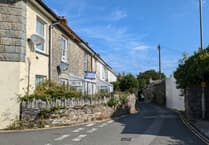
Emily Hobhouse was born and grew up in St Ive, near Liskeard, and was the daughter of Anglican rector Reginald Hobhouse, the first Archdeacon of Bodmin. She spent her early adulthood caring for her sick father, but after his death, and aged 35, she went to Minnesota to perform welfare work among Cornish miners.
On returning to Britain just before the outbreak of the Second Boer War in 1899, Emily was invited to become secretary of the women's branch of the South African Conciliation Committee. Learning of the appalling conditions endured by Boer woman and children in the British concentration camps, she founded a distress fund and sailed for the Cape Colony in December 1900. She became an ardent welfare campaigner, bringing the horrific reality of the camps to the attention of the British people.
She made five trips to South Africa, campaigning to have conditions improved and taking supplies into the camps herself. Post war, she set up weaving schools to give the women skills which would help them to rebuild their lives.


Emily's work to improve the lives of the Boer people led to her being celebrated as a national heroine in South Africa. The town of Hobhouse in Eastern Free State is named after Emily and her ashes are interred at the national women's monument in Bloemfontein.
Unbeknown to her, the sum of £2,300 was collected by the Afrikaner nation in gratitude for her humanitarian work, with the request that this be used to buy a house for her on the Cornish coast. This wish was fulfilled and Emily lived out her final days at her home in St Ives, which became part of the Porthminster Hotel.
Yet her death, and details of her achievements, have been largely ignored in her home county.
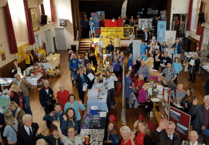
In December, South Africa will mark the centenary of the inauguration of the women's monument, and with an arts festival planned, Lions Head productions are making a film about Emily's early life. Having filmed at St Ive in the church where Emily's father was rector, the crew were in Liskeard to take footage of an exhibition being put together at the Liskeard and District Museum.
Herman Binge, of Lion's Head productions, was surprised Emily is such a little-known figure in her hometown.
'She was one of only five people interred at the national women's memorial, which shows the kind of status she enjoys in South Africa,' he said.
'Her eulogy was written by Gandhi. She saved thousands of lives, but she was disowned by a part of British society,' said Mr Binge, who revealed that Emily Hobhouse 'wrote fondly of shopping trips into Liskeard from St Ive'.
Liskeard and District Museum curator Anna Monks is hoping events planned for later this year will bring Emily to wider attention.
An exhibition is to be launched in November, and a workshop focusing on Emily as an important female historical figure will also take place in Liskeard.
Comments
We've recently changed our login process. If you have an account for commenting, you will need to re-register on the login window.
This article has no comments yet. Be the first to leave a comment.