

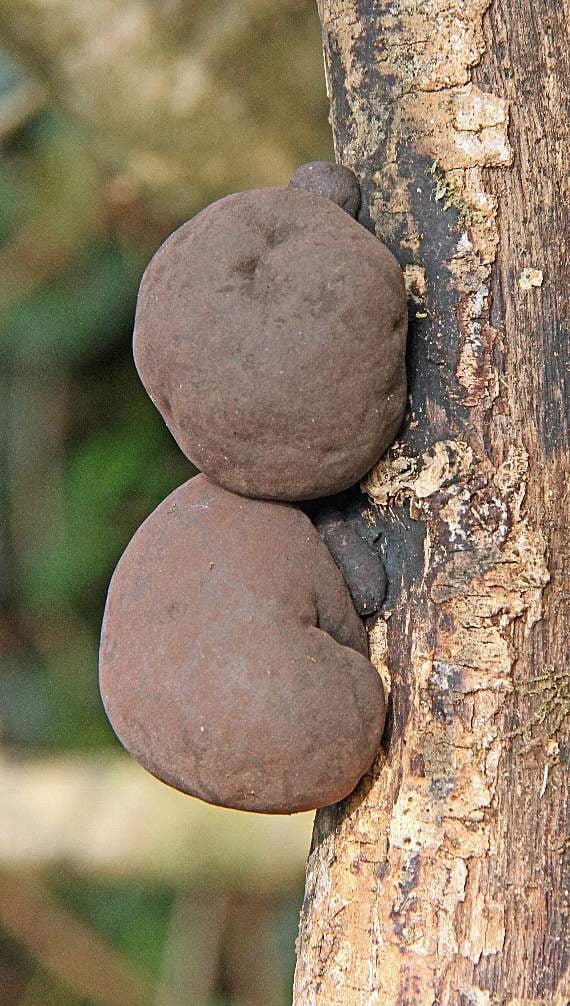
King Alfred’s cakes is one of the most easily recognised fungi in the country and is probably the only one we ever learnt about whilst we were at school. These black, hard, knobbly balls that can be seen all year round grow on dead or dying branches of deciduous trees, particularly ash.
Legend has it that they are so named after King Alfred, who ruled from 871 – 899AD. He was wandering around the countryside when a peasant lady asked him to watch some cakes that she had baking. But Alfred was so preoccupied, thinking about how he could deal with the next Viking raid on England, that the cakes burnt. When the lady returned and noticed her cakes were black, she shouted at Alfred and called him lazy, so the name for that inedible fungus was born.
I was on my walk down through Muddy Lane to the road that would take me back to the village when I saw some of these inedible fungi that do look like burnt cakes. Also on the hedge were some sycamore branches that had been trimmed back and seeping from the cut ends was some white and orange sap. A bit like a rubber tree I thought.
Down by Hepwell Farm the high bank that was covered in vegetation, had loads of soft comfrey – Symphytum orientale – out in bloom with their white, tubular flowers. Although books will tell you that these plants bloom from May onwards, these on the bank look as if they are dying off, in March.



In one of the gateways beside the road I spotted some lovely blue flowers of germander speedwell – Veronica chamaedrys – growing in the hedge creep of the field. These small blooms set amongst green foliage once reminded people of eyes, thus giving them the name ‘birds-eye speedwell’ and ‘blue birds eye’.
Bluebells are sending up their long leaves and I noticed one of them on the hedge, was on its way up, taking with it an empty snails shell that must have been lying on the soil as the leaf burst through the ground. During May we shall see a beautiful sea of blue in the woods down below Quethiock. Hopefully nobody will dump any Spanish bluebells that they have dug up from their garden when they have outgrown their allocated space. These Spanish invaders – Scilla hispanica – hybridise with our native bluebells – Scilla non-scripta – and produce a blue flower that does not droop to one side.
The white flowers of barren strawberry – Potentilla sterilis – that may be seen on the hedgerow nowadays, can easily be mistaken for the wild (and sweet) strawberry flower, but looking closely the five petals have gaps between them. Their yellowish fruits never become red and fleshy like those of the truly wild variety.