
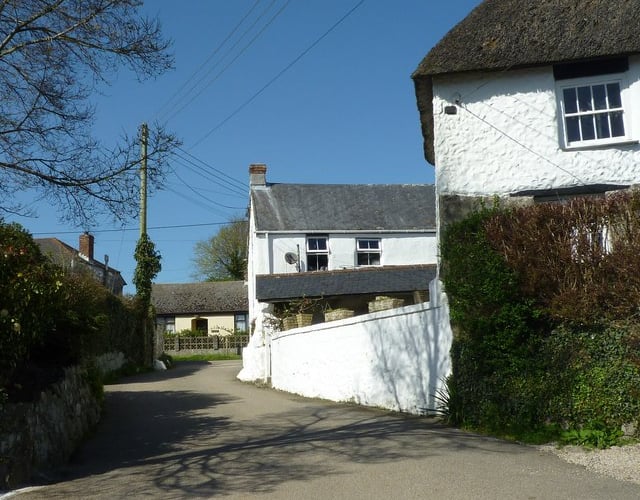
Ros an Eythin: Ros - hill/spur; An – the; Eythin – gorse
What3words - ///documents.rockets.cupboards
Ros an Eythin yw gwig vyghan ogas dhe Lannaghevran, dhe’n Lysardh. Styr y hanow yw ‘ros ha dhedhi eythin’. Nyns yw an wig pell dhyworth an arvor hag yma trolergh a led dre nebes prasow dhe dreth, Porth Godrevi y hanow, ha dhe’n hyns arvorek. Trolergh aral a led dres bre dhe Lannaghevran, an dreveglos a re hy hanow dhe’n bluw.
Nyns eus meur yn Ros an Eythin marnas nebes treven byghan, mes Mengleudh an Din ha’n mengleudhyow Porth Ewstek yma omma yn ogas. Pur vysi yn termyn eus passys, ow provia meyn a veu usys dhe vyldya fordhow, an mengleudhyow yw gesys dhe goll lemmyn.
Ryb an vownder ynter an wig ha Porth Ewstek y hyllir trovya ‘Koytys an Kowr’, graghell naturek a veyn, a wre sevel war leder ogas dhe Benn Meneglos. Byttegyns, yn 1967 an veyn a veu movys dh’aga le y’n jydh hedhyw awos omlesans an mengleudh dh’aga godros.
Rosenithon is a little hamlet near St Keverne, on the Lizard. Its name means ‘hill-spur of gorse’. The hamlet isn’t far from the coast and there is a footpath which runs through a few fields to a beach, Godrevy Cove, and to the coastal path. Another footpath leads over a hill to St Keverne, the village which gives its name to the parish.
There are only a few small houses in Rosenithon, but Dean Quarry and the Porthoustock quarries are nearby. Very busy in the past, providing stone to make roads, the quarries are now abandoned.
Next to the road between the hamlet and Porthoustock one can find ‘The Giant’s Quoits’, a natural pile of stones, which used to stand on a slope near Manacles Point. However, in 1967 the stones were moved to their present situation, as they were threatened by the expansion of the quarry.
With thanks to Cornish language organisation An Rosweyth. www.speakcornish.com
Comments
We've recently changed our login process. If you have an account for commenting, you will need to re-register on the login window.
This article has no comments yet. Be the first to leave a comment.