

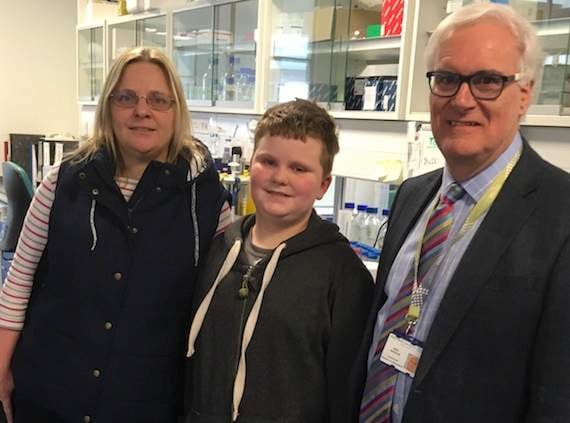
An 11-year-old with Type 1 diabetes had a unique chance to visit boffins undertaking ground-breaking research into his condition.
Daniel Lindley and his mum Karen joined a tour of the Islet Cell Biology lab at the University of Exeter Medical School to meet Professor Noel Morgan and other researchers who are funded by Diabetes UK.
The visitors learnt how Professor Morgan and his team have access to a rare set of pancreas samples, taken from people who had been recently diagnosed with Type 1 diabetes.
In Type 1 diabetes, the body’s immune system attacks insulin-producing cells in the pancreas, but no one currently knows how or why.




By studying pancreas samples, the Exeter team is hoping to understand more about the immune attack in a bid to develop new treatments that stop or prevent Type 1 diabetes.
Daniel, from Lostwithiel, had the opportunity to study clusters of insulin-producing cells, known as islets, through a microscope and even watch cells communicating with each other on a computer screen, thanks to special dyes that make them fluorescent.
The Fowey River Academy schoolboy, who was diagnosed with Type 1 diabetes at the age of six and relies on daily doses of insulin to stay alive, is now interested in a career in scientific research.
He and his mother Karen Lindley are members of SKYD (Supporting Kernow Young Diabetics), a Diabetes UK support group which raises money for research.
After the visit, Karen said: ‘What they are doing in Exeter is unbelievable.
‘I feel one hundred per cent positive that diabetes research is going somewhere and will help generations to come.
‘And what was clear is that the researchers were not just there to show us around; they’re there for our future. They care.’
Professor Morgan, director of the Institute of Biomedical and Clinical Science at Exeter Medical School, said: ‘The visit was incredibly valuable for our team and very humbling.
‘There is nothing like being able to talk to people affected by diabetes.
‘Their enthusiasm for our work was inspiring and made us realise that we have to keep doing this and do our best for people living with diabetes.’
Diabetes UK invests around £7 million every year to bring about breakthroughs in care, treatment and prevention, bringing us closer to a cure.
Dr Emily Burns, head of research communications at Diabetes UK, said: ‘By funding critical research like Professor Morgan’s, we’re hoping to develop new insights into how Type 1 diabetes develops and what needs to be done to stop it.
‘We’re only able to fund world-class research thanks to the generosity of our supporters, and we’re thrilled that Daniel and Karen had the opportunity to see it first-hand.’
To find out more about research into diabetes, go to www.diabetes.org.uk/research.
Comments
We've recently changed our login process. If you have an account for commenting, you will need to re-register on the login window.
This article has no comments yet. Be the first to leave a comment.