

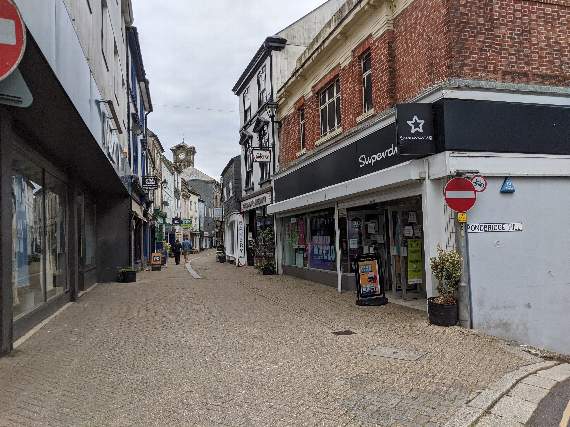
SOUTH East Cornwall’s town centres will start to look more like normal from Monday as non-essential retailers begin to open their doors to customers.
Traders will have to meet criteria and demonstrate that they are adhering to new guidelines to protect staff and shoppers.
Libraries, heritage sites and gift shops in museums will also be allowed to open, indicating a gradual return to a full reopening of the hospitality sector.
But with just £152,000 of Government money passed to the local authority to invest across the whole of the county’s re-opening the high street safely effort, the operational cost will largely fall to local councils, or to the businesses already under huge financial pressure.




Coastal areas have been particularly badly hit by the impacts of the coronavirus pandemic: seven of the ten towns in the UK with the biggest rise in unemployment at the start of the outbreak are in Cornwall, and include Looe, Bude, Padstow and Wadebridge.
While business owners want custom, there is caution around re-opening and how footfall can be safely managed.
In Looe and Liskeard, town councils are consulting with traders and residents over ideas such as pedestrianisation of some areas, suspension of parking enforcement, and systems to manage people and vehicles as they move around.
Both Government and Cornwall Council have produced a lot of guidance aimed at helping traders get it right when they re-open, but it will be up to town and parish councils, traders’ associations, and individual businesses to find the way forward that best suits them, said CALC (Cornwall Association of Local Councils) chief executive Sarah Mason.
At a meeting led by CALC last week, councils from across the county met to discuss re-opening the high street. Ms Mason pointed out that the ‘high street’ in Cornwall does not necessarily just mean the main street through a town centre, but applies also to rural hubs and ‘any space where shops begin to trade safely for people’.
Ms Mason praised the efforts of the ‘proactive’ town council in Looe, who are keen to get open again in a way that works for the community as well as serving the traders.
In Liskeard, the town council and businesses have also been discussing ideas such as: safe queuing outside shops; traffic regulation in areas with narrow pavements; temporary pedestrianisation; how to make it easier for cyclists; the possibility of removing parking enforcement on town centre streets; and ways to help more trade take place outside.
On the last point, Cornwall Council has relaxed the requirement for planning permission for seating and tables outside in order to help with social distancing.
‘Re-opening the high street is something communities are nervous about, it brings people in and encourages them to move around, and we’re in a very strange place at the moment where half of us think we need to stay at home and the other half thinks we need to come out,’ said Ms Mason. ‘Towns are taking an individual approach based on their area because what’s right for one place won’t be right for all.
‘Cornwall Council will be as supportive as it possibly can.’
Toilets are another tricky issue that local councils have to grapple with as trading resumes. In Looe, the council firstly opened its disabled toilets, but the facility at the seafront had to be closed temporarily after an incident of abuse towards one of the cleaners. All the toilets will be re-opened this weekend, said the town clerk.
While councils may want to open public conveniences, the self-employed contractors or volunteers who look after them may be unwilling or unable to return to work, and the logistics of toilet safety in terms of COVID-19 are also a great challenge, said Ms Mason.
‘We are such a hospitality-based county. The re-opening of Cornwall PLC is going to be an incredibly difficult thing to do safely, and retain people’s confidence.’