
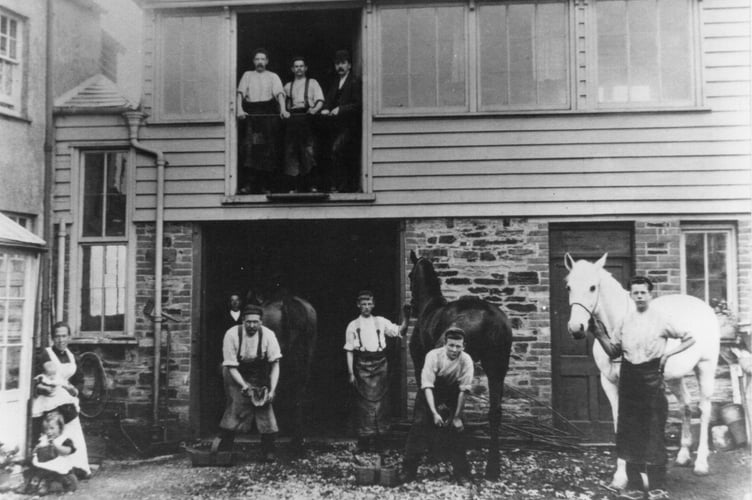
ON March 2, 1899, the Western Daily Mercury contained the headline ‘Shocking Accident at Liskeard’.


It was reported that ‘Yesterday, while Mrs J H Davey, of Castle Street, Liskeard, was attending to the kitchen range in her house, a spark caught her apron, and, quickly spreading, she was soon enveloped in flames. The only person near was the servant; she lost all presence of mind, and not stopping to put out the fire, rushed out into the street shouting “Fire!” Before the flames were subdued the poor woman was terribly burned and suffered great pain. Doctors Carter and Nettle attended quickly, but the accident is a serious one, as the unfortunate woman had been ill for some time, and only got about again on Monday.’
Jessie Davey died three days later leaving behind a husband John Hawken Davey, a blacksmith and mechanical engineer in Greenbank Road, a 16-year-old son Leonard and a 13-year-old daughter Winifred. Jessie’s nephew Edwin Spurway, in business in Lower Lux Street as a Tailor, was an Alderman of the Borough Council until 1949, served four terms as mayor, and became a Freeman of the Borough on November 29, 1944.
The domestic servant who ‘lost all presence of mind’ was 23-year-old Ida Ellen O’Connell. She left Liskeard for Plymouth soon after the accident, where she found employment as a housemaid for 47-year-old widow Edith Hitchings, who was born in Allahabad, India, at 9 West Hoe Terrace. Ida married an assistant storeman at the government’s Victualler Yard in 1905 and settled in Plymouth, where she had a son and a daughter, and died in 1957 aged 81.
One of the first doctors on the scene was William Henry St Leger Carter LRCP and S Edin, of Rosedean Surgery in Dean Street. In the 1891 census for Ingledean, Dean Street, Dr Carter’s place of birth was given as ‘at sea off the Cape of Good Hope’, all seven of his siblings were given the middle name St Leger. Dr Carter married Mabel Edith Lang in 1894 and gave both their children the middle name St Leger. Mabel’s father Thomas was the contractor on the Moorswater and Liskeard railway viaducts and the restoration of Lanhydrock House in 1881.
Two months before the accident Dr Carter was mentioned in the Cornubian newspaper beneath the headline ‘Extraordinary Outrage at Liskeard’. A man from Herodsfoot named James Tarrie had been stabbed and taken to Rosedean Surgery where Dr Carter dressed the wound which he described, while giving evidence in court later, as ‘extending from the shoulder down the back of the arm, about seven inches long, and was one inch deep, [I] put in sixteen stitches’. When Sergeant Pearn had arrived at the scene of the stabbing he found William Kent lounging against a hedge near the railway station in possession of a pruning knife. As Kent was being escorted to the police station he was ‘under the influence of liquor, was exceedingly furious and abusive, threatening to blow out the sergeant’s brains with a revolver if he could get one’. Kent was charged before the mayor, Mr W A Jenkin, and remanded in custody at Bodmin Gaol until Tarrie had recovered enough to give evidence at a trial.
Comments
We've recently changed our login process. If you have an account for commenting, you will need to re-register on the login window.
This article has no comments yet. Be the first to leave a comment.