

In this week’s Nature Watch, photographer Ray Roberts takes us on a stroll down the lanes near his home and reflects on the variety of wildflowers that have popped up in the hedges as a result of the recent rainfall.
Like lots of gardeners and farmers, I was really pleased to see some rain. I could not sleep at night as I could hear my runner-beans and onions crying out for a drink. I have seven rain water butts and they were all empty.
The rain has certainly made a difference to the hedgerows as there are a lot of different flowers to look at including the white trumpet-like flowers of hedge bindweed – Calystegia sepium – on their long climbing stems that wind themselves around any handy shrub or tree. The blooms stay open throughout the night and catch the first light of dawn when the live up to their West Country name of ‘morning glory’. They attract bees and small flies that can crawl into the flower to get at the nectar.
However, the plant is a well-known garden invader and will even come through the tiniest crack into a greenhouse where they enjoy the warmth to extend their runners and climb up over the tomato plants or even just grow across the floor. When you pick these weeds off the garden or from the greenhouse do not throw them onto the compost heap as even the shortest piece of stem will take root and grow.




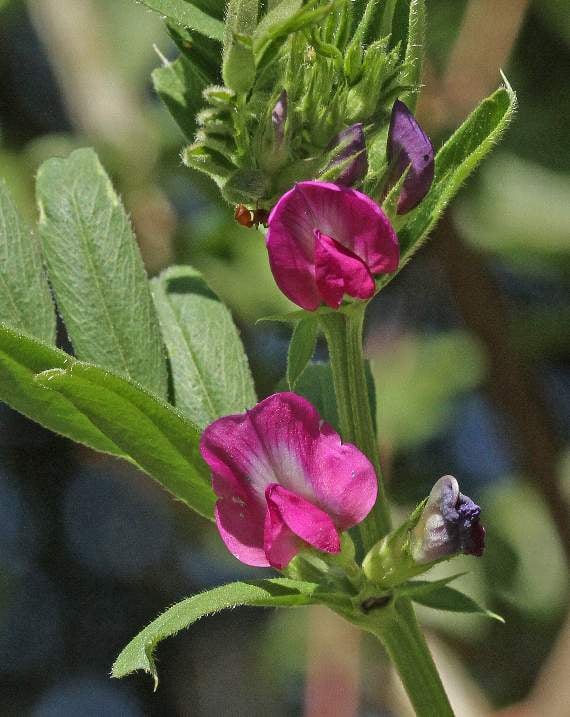
I walked down to Trehunsey Bridge and saw a lot of common vetch – Vicia sativa – on the way with their red flowers that are similar to those of peas. Indeed, the seeds are contained in a hairy pod and were once used as pigeon food. Tufted vetch – Vicia cracca – has purple blooms and uses long, branch tendrils on the ends of its leaves to climb up and along hedgerows.
Also, on the way down the hill I saw lots of narrow-leaved birds-foot-trefoil – Lotus glaber - growing with their yellow flowers that, like the common vetch, are similar to pea flowers. Hedge woundwort – Stachys sylvatica – likes well drained soil and has dull reddish flowers with leaves that give off a rather unpleasant smell. These leaves however, contain a mild antiseptic and have been used since the sixteenth century to cover cuts, or wounds, on arms and legs to help the healing process.
There were loads of hover flies busy on the flowers and one of the largest and probably the commonest, is the Syrphus ribesii that can be seen in the hedges and gardens. They feed on nectar and can easily be mistaken for wasps but are quite harmless.
Walking across a path field I noticed an abandoned drinking trough that used to provide water for cattle. The water in the trough was covered with tightly packed duckweed and standing on it was a small young newt around 40mm in length. Now, I thought, how did the parent newts know the water trough was in the field because the nearest stream was probably a mile away and how did the duckweed get there in the first place?