

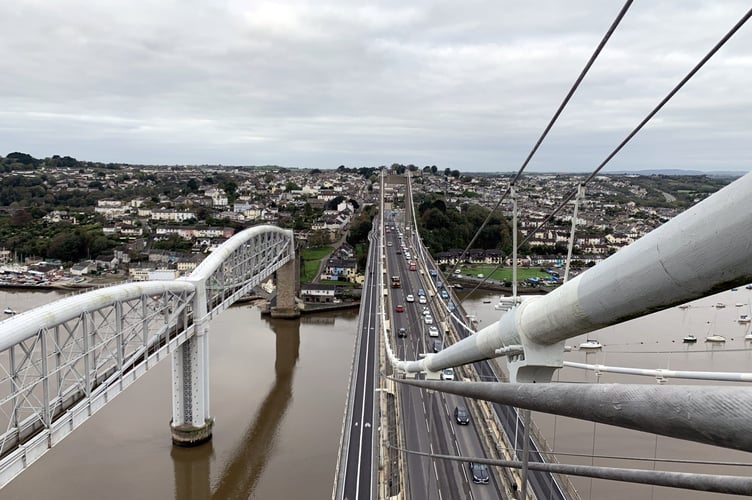
CORNWALL Council stands accused of reducing the issue of future financing for the Tamar Bridge and Torpoint Ferry to a “meaningless soundbite” in its Devolution Deal.
In the Deal’s summary document, published by Government, the transport network as a whole has several paragraphs but there is just one short point relating to the bridge and ferry.
It states: “The Tamar crossings provide strategic infrastructure connecting Cornwall with Plymouth.
“Cornwall Council and its partner Plymouth City Council will continue to work together for a sustainable future for the crossings. Together with government, they will consider options for future legislation to enable a more efficient toll revision process.”
.jpg?width=209&height=140&crop=209:145,smart&quality=75)



The Cornwall Council version of the Devolution Deal document published on the public consultation page words things slightly more optimistically: “The Deal would commit Government to working with Cornwall (and its partner Plymouth City Council) to plan for a sustainable future for the Tamar Bridge and Torpoint Ferry.”
The Tamar Toll Action Group (TTAG) was founded in May 2022 to campaign for toll-free crossings.
Referring to the Devolution Deal’s paragraph on the crossings, vice chairman Scott Slavin said: “I’m afraid we consider this a meaningless soundbite given the criticality of this issue to local residents and businesses.
“It does not give any information on what is proposed, nor what the strategy is to be for achieving it.”
Mr Slavin said he feared that on the cards is an application to Government, giving the Joint Committee managing the crossings the right to make annual toll increases in line with the Retail Prince Index (RPI).
The Committee has previously stated that the ability to index tolls using RPI “would not mean that tolls must increase by that index, rather it would set a ceiling on the ability to increase tolls to levels that ensure that funding for operation and maintenance remains sufficient”.
But the action group stressed that such a move would “negate the Joint Committee having to go to public consultation for increases, and also negate the need to get each increase approved by the Secretary of State for Transport”.
“In effect, the users will lose their right to raise objections,” he said.
“We will oppose this change and encourage our members to do likewise.”
Scott Slavin and TTAG treasurer Lee Lidstone were among those attending last week’s Cornwall Devolution Deal public event in Saltash.
Leader of Cornwall Council Cllr Linda Taylor and cabinet member Cllr Olly Monk presented the different aspects of the Deal and took questions from the floor.
Mr Slavin said that Transport had been the last item mentioned on a list of areas to be targeted with some of the Devolution Deal funding.
“I said that I was glad Cllr Taylor had mentioned Transport, as the elephant outside the room - for all the residents of this town and most of SE Cornwall - was the Tamar Bridge that we could see outside the windows.
“The reply was that they would come back to that later and then they moved to another question.
“They did come back to the Tamar Bridge later, but only to state that the Councillors and the Joint Committee never allow them to forget it. I found this to be a statement with little substance.”
The Tamar Bridge and Torpoint Ferry Joint Committee is made up of Councillors from across the political spectrum from both Plymouth City Council and Cornwall Council.
The Committee has said that both it, and the parent authorities, have been calling on the Government for a number of years to provide long-term financial support for the two crossings.
Prior to the recent toll increase, the committee reiterated that: “all partners are keen that there should be a solution where the bridge and ferry continue to operate within a single organisation and the objective is to achieve practical support that maintains this structure”.
We asked Cornwall Council if the Devolution Deal dials back on its commitment to press Government for practical support for the crossings - and in effect represents an agreement to confine the committee to passing the cost of maintaining the crossings onto the user via inflation-linked rises. At the time of going to print we had not received a response.
Comments
This article has no comments yet. Be the first to leave a comment.