

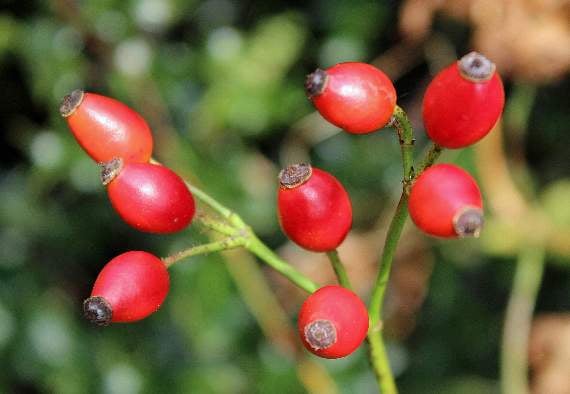
There’s food for the birds - and even a hedgerow treat for the photographer - as Ray Roberts takes a Nature Watch walk along the River Fowey.
For a change of scenery I took a short, but pleasant walk beside the River Fowey and stopped for a while, in what could be called a glade with autumnal beech trees layering the ground with reddish-orange leaves. These leaves have been producing food for its tree by photosynthesis during the summer months and now after their supply of sap is closed off, they dry out, turn yellow and drop off.
There are over a couple of dozen different Waxcap mushrooms in our country and I came across a group growing on a mossy hedge near the bridge. They had yellow caps, gills and stems and were very slimy and sticky. I think they were Hygrocybe vitellina and I read they are fairly rare. Very pretty to look at too, they stand out well on the green damp moss so are easy to spot, looking just like flowers.
Walking around the village I noticed some artichoke galls on the short scrubby oak trees that are growing on the hedges. These galls are caused by the wasp Andricus foecundatrix that lays a single egg in the leaf bud of the tree and when they first form, they give the appearance of a garden artichoke. Oak trees are used by several different small wasps as a place to lay their eggs and the most common gall we see is probably the round brown marble gall caused by the tiny wasp Andricus kollari.
There are lots of rose hips, the fruit of wild roses, on the hedges now. During the Second World War these hips were collected as they are rich in vitamin C and used to make rose-hip syrup as oranges were in very short supply. It has been said that the two and half million bottles of syrup produced contained as much vitamin C as twenty-five million oranges.
We get loads of wild birds of all kinds in our garden now and I spotted a rather fat female blackbird sitting quietly just looking around. I can’t help thinking that they rely on the food that we put out, but it is costing me a bomb for bags of sunflower seeds, which they love, and fat balls. Seriously though, once you start to feed wild birds and squirrels it is very important to carry on doing so, especially in the winter months.
Whilst out walking on Saturday I could hear lambs in a field beside the road. Of course, that made me walk closer to have a look and there were several lambs, with their mums and I could see that they were only a few days old. Usually, I thought lambs come around Christmas time but, as with a lot of things nowadays, farming has changed.
I had another surprise on the nearby road hedge, there was a ripe, wild strawberry that was nearly as big as a marble. There were also a couple of small unripe berries on the same stem and I must say that the ripe one went down very tastily.