

I walked almost a mile down to Trehunist and noticed that the leaves on both elder and hazel trees are taking shape and several blackthorns were sporting their white blossom. Blackthorn trees flower before their leaves appear but hawthorns are opposite, their leaves open up before the flowers appear.
As usual when I travel down that road a buzzard is always watching me from its perch on a telegraph pole and there it was today. As I got closer to it the large bird swooped down and landed in a field not far from the gateway, so I was able to photograph it.
When I got to Trehunist I walked right through the hamlet to where there is a narrow road that goes down to a ford and then uphill, past Haye Farm to the Pounda road. There is a sign at the turning that says the ford, across the track, is 500 yards away. Well, when I walked down it a couple of years ago the sign read 100 yards but whoever updated it forgot the add the original 100 yards because I reckon the ford is a good 600 yards down the hill.
Known locally as Haye Lane the hedges are decorated with hundreds of lesser celandines and some small blue flowers that I spotted were ground ivy – Glechoma hederacea – with their stem wrapped around a dry fern stalk. This plant is no relation to larger common ivy that climbs trees and old walls for support, but they both retain their green leaves throughout the year.


The small leaves of the ground ivy, known then as ale-hoof, were used by the early Saxons to clarify and to add flavour to beer during brewing. But then, from the reign of Henry VIII, hops were used in the production of ale. Their leaves can be gathered in the spring and early summer as an additive to salad to sharpen its taste.
Every now and again I see some flowers of hogweed – Heracleum sphondylium – that have pink edges on their white umbels and I spotted a single bloom on the roadside near Pounda. There were large clumps of scurvygrass – Cochlearia officinalis - on the road hedges all out in white flowers. In the days of sailing ships this plant was a life saver because on long sea voyages that lasted for several months, sailors would get scurvy, due basically to the men having no vitamin C in their diet that consisted mainly of salt pork and dry biscuits.
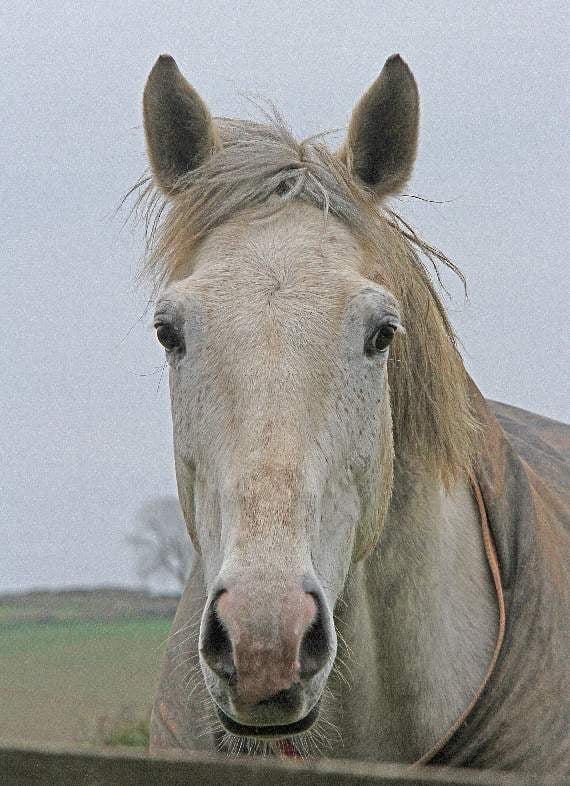
Leaves of scurvy grass – if ever a plant was misnamed this was it as the leaves look nothing like grass – provided the required vitamin that prevented the dreaded scurvy. It was later found that limes also provide vitamin C, so crates of these were taken on voyages. This is probably how English sailors acquired the name ‘Limeys’. When I looked into a field near Trecorme Mill a white horse came over, probably to see if I was carrying an apple in my pocket that I could offer it.