

Photographer Ray Roberts looks closely down at the ground and up to the tops of tall trees to find subjects for this week’s Nature Watch .....
I caught a lift up to St Ive so I could walk back the one and half miles. There is a rookery in the tall trees opposite the church and the rooks were busy renovating their nests. Pairs of these birds repair and use the same nest every year, so it’s not a case of the strongest birds claiming a nest that might not need much work done on it before the egg laying begins. How is it, I thought, that these birds are so different from us? I mean, we would take the best nest on a first come, first served basis.
Rooks eat corn, fruit and insects but are not really fussy about their food as they sometimes can be seen digging in soft soil to find earthworms and other invertebrates to eat, of course hot summers that bake the ground hard are really bad for them. No problem so far this year then with all the rain we have had.
As I walked back to Quethiock I noticed several wild strawberry flowers on the hedges. Let’s hope we have some decent weather so these pretty little white blooms can produce their tiny sweet fruits that are really a pleasure to pick and eat whilst out walking.


-Cllr-Leigh-Frost-Jayne-Kirkham-MP-Perran-Moon-MP-Noah-Law-MP-Gus-Grand-Piers-Guy-in-a-geotherm.jpeg?width=209&height=140&crop=209:145,smart&quality=75)
At last, I found some wild daffodils – Narcissus pseudonarcissus – growing on the hedge but virtually hidden beneath a covering of brambles. In my opinion these daffs are the best of the lot, easily better than all the other cultivated ones that are now becoming popular. I can remember, some years ago, reading about a chap who cut a hole in a large beetroot and planted a wild daffodil in it. He kept it damp in his greenhouse and produced a bloom that was a shade of red. I wonder if he went into large scale production of that variant.
When I come across an open field gate, I always take a look in to see what wild plants are growing in the field and in one of them I found some self-heal – Prunella vulgaris – just coming into bloom. Although their flowers are usually violet/purple in colour they are occasionally pink or red. The plant gets its name from when farm workers used the leaves to heal cuts made from scythes and paring hooks.
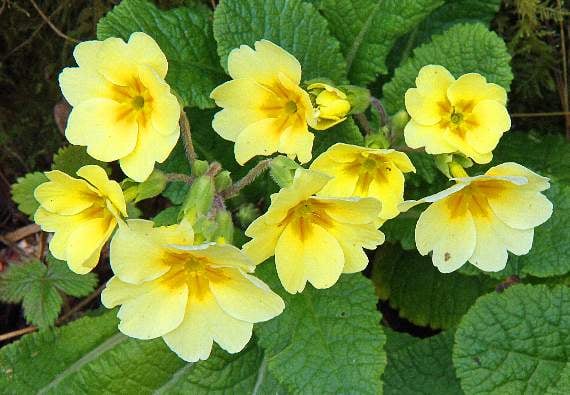
Back near the village there are a couple of primroses growing on the hedge creep with their pretty yellow flowers on them. When they finish blooming, I am going to dig them up, I know that is illegal, and plant them halfway up the hedge, because one day Cornwall Council might send a gang of workers and a mechanical digger to dig the soil and plants up from where they are growing on the tarmac, thus making the road neat and tidy. Well, one can always hope!
There are lots of alexanders – Smyrnium oleraceum – coming into bud now and on one of the few sunny days I noticed several yellow dung-flies on them in search of some early pollen. As the name suggests, these flies swarm around cow dung where they mate and lay their eggs.