

We both decided to take a walk up Birch Hill – boy, quite a climb – and go down the other side to Hammet then up to Pipers Pool, leaving us with an almost flat length of road to bring us back to the village. Probably a two mile circuit altogether and to make the walk more interesting it began to rain at the half-way stage.
Red campions were still in bloom on the hedges as were the occasional herb bennet with their yellow flowers turning into small ‘sticky button’ seed capsules. Several betony flowers were seen as well as lots of herb Robert flowers and on the blackthorn trees we counted half a dozen sloe berries. Not many I know, but we can’t have thousands of these sour berries every year.
There were several puff-ball on the hedge on the way down to the farm. These were – Calvatia utriformis – and were about 50mm across. They grow out from the soil on a thick stem into what might be called a pear shaped body that has a rough, warty surface that eventually turns brown, splits open and releases thousands of brown spores.
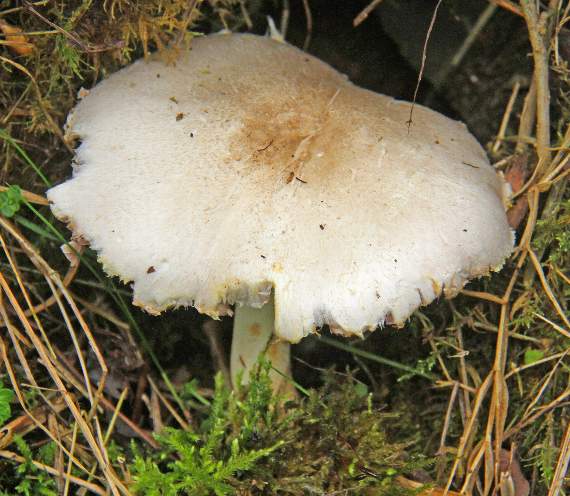
We also found were a couple of whitish mushrooms on the hedge that looked very much like the common field variety – Agaricus campestris. However, after I cleared away some of the leaves that were surrounding them, I could see yellow markings where the flesh had been bruised on the stems, making them yellow stainer mushrooms - Agaricus xanthodermus – that are best left alone.




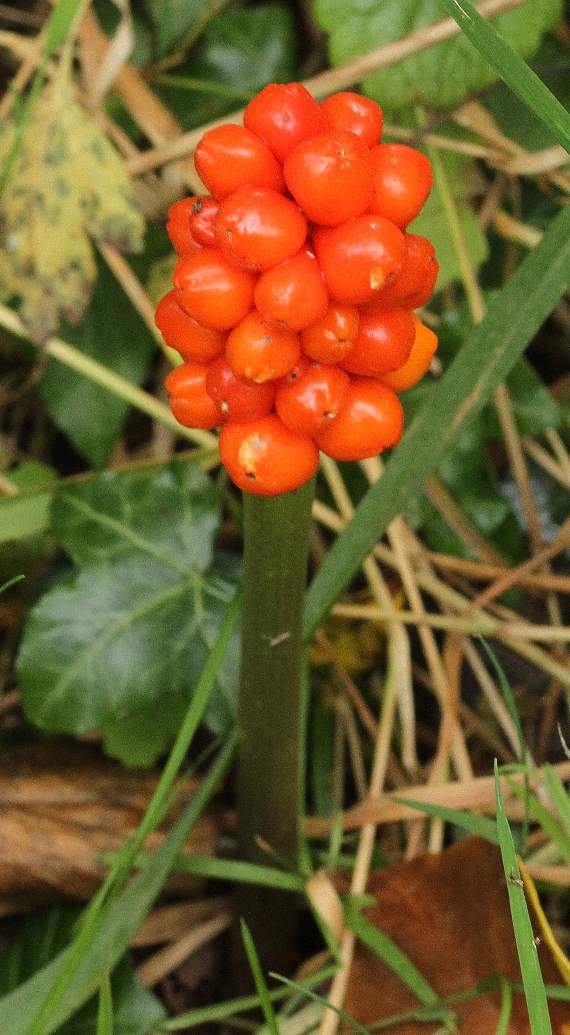
Hidden away beneath the overgrown greenery were several clusters of scarlet berries on the long stems of Lords and Ladies plants. These berries ripen when the long purple spadix, or flower, dies off and I have never seen a bird or small animal eating the berries as they are extremely poisonous to man and beast. The roots of Lords and Ladies were once gathered for their high starch content and used to stiffen the high, stand up collars that were once fashionable.
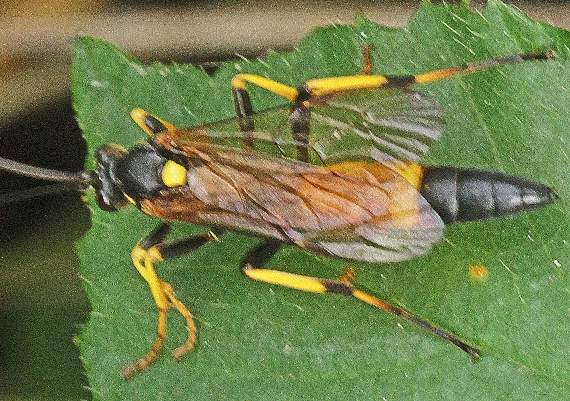
A large fly-like insect was flitting around and I managed to get just one picture of it before it decided to fly over the hedge into a field. I could see that it was an ichneumon fly, with a body length of probably 35mm and its yellow legs were unmistakable. This is just the second time I have seen one of these flies and I hope the next time it will sit still for a minute whilst I get some sharp photographs.
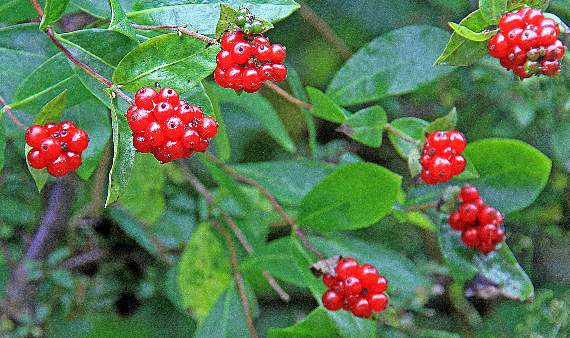
All the climbing honeysuckle plants have now lost their flowers and are sporting red berries that are very attractive to look at and provide food for a variety of birds.
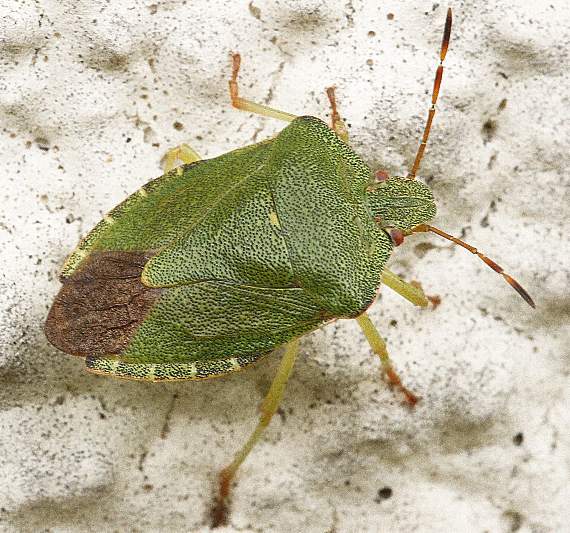
Arriving home we found a green shield bug waiting on the wall beside the front door as if it was hoping to be invited in away from the drizzle. This little bug is about 14 to 16mm long and feeds on the sap of flowers and trees, hazel being a favourite. Their other name is stinkbug as they have glands on their underside, from which they secrete a foul smelling fluid.