
EACH week, hundreds of planning applications come before Cornwall Council’s planning department, seeking to win approval for various plans right across the Duchy.
These plans can comprise of a number of different reasonings – ranging from permission to replace windows or listed building consent ranging up to large house building developments or changing of use of a building, for instance, from an office to a café, or flats.
Within this large and often complex system, there are a number of formats from which planning advice and approval can be sought.
These range from full applications where all the details which comprise a proposed development or work to a building are submitted, to outline applications, where further details are yet to be confirmed, for example, an outline application with reserved matters for appearance may not confirm the final proposed development but rather seek permission in principle.


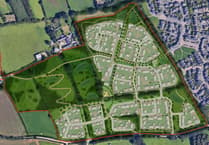
An example of this is one for an outline permission for 20 dwellings on land with reserved matters for appearance and scale; the reserved matters would require further permission later for their inclusion.
Other types of applications include pre-application advice requests, where would-be developers submit often outline proposals to a local authority to ascertain whether it is likely to gain support or not prior to submitting a planning application.
The vast majority of applications are decided by planning officers employed by a local authority under ‘delegated powers’, meaning they do so on behalf of their employer, however, some applications are ‘called in’ by local councillors to be discussed at an area’s strategic planning committee meeting, meaning the final decision rests with a committee of councillors.
Bungalow could be replaced
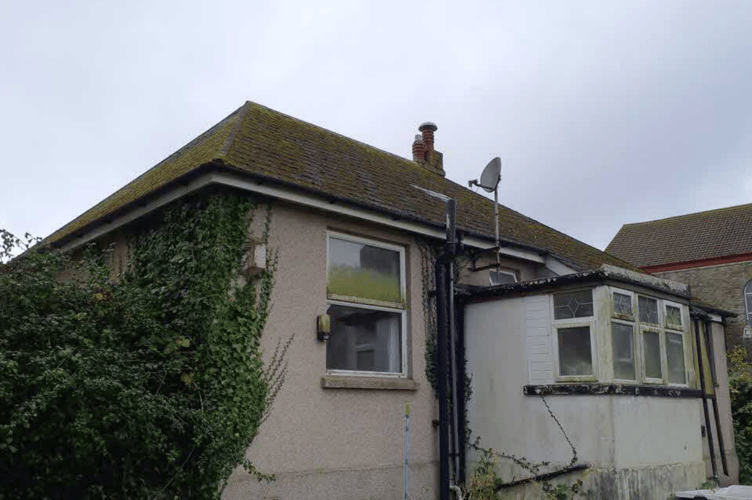
A BUNGALOW in Callington which is affected by mundic construction could be demolished and replaced with six dwellings.
If approved, the bungalow known as Wisteria on Haye Road in the town would be removed in order to enable six two-bedroom houses to be built in its place.
Documents submitted on the applicant’s behalf by the planning agent stated: “The 0.2ha site subject of these proposals lies in the Conservation Area in the centre of the historic market town of Callington in close proximity to the town’s main thoroughfare ‘Fore Street’ and adjacent to the graveyard garden of St Mary’s Church.
“The layout of the scheme has been designed with its Grade I Listed neighbour uppermost in mind, with the siting of the new homes set out in such a way as to frame views of the imposing tower elevation of St Mary’s Church and make it the visual and symbolic head of this development.
“At present much of the development site is inaccessible, being captured behind the 20th century bungalow of mundic block construction on Haye Road. The bungalow is somewhat dilapidated and of poor quality materiality and sits somewhat incongruously amongst the historic environment in this town centre location.
“The demolition of the bungalow will provide a generous entrance to the new development and an opportunity to significantly improve the street scene and the setting of the grade II listed WI Hall which it presently sits alongside.
“The proposal is for six new modest detached homes set amongst open green spaces. The designs are of a typical one and a half storey design with first floor accommodation being within the roof silhouette.
“The new dwellings sit quietly within the site and are arranged to follow the pattern of the existing town centre housing stock but importantly also to create a dialogue to St Mary's Church.
“The layout of each dwelling is simple, providing front and back doors and ample breathing space between to encourage social and civic interaction and to create opportunities for green open spaces both private and public. The houses are of a suitable scale with ridge and eaves levels commensurate to the surrounding houses, being suitably humble and subordinate in relation to the more important civic scale of the church and WI buildings.
“The layout of the dwellings and the open nature of the entrance from Haye Road, provides an intermezzo in the street scene and welcomes interaction, creating ample space for vehicular, bike and pedestrian access.”
Details of how the new housing would look and function was also detailed, with the applicant stating: “The designs are unashamedly traditional in their essential form but built in a contemporary manner and built to sustainable standards with super insulation and opportunities for passive solar gain where possible.
“The materials are to be natural and sustainable such that the dwellings can be enhanced by the patina of time. The arrangement of each design respects its neighbours as best it can, with fenestration choreographed to maintain privacy while still creating well lit internal spaces with good vistas set up wherever possible.
“The architectural language with regard to the streetscene is intended to again be traditional and to promote a sense of place, civicness and pride. Spaces to share but also to encourage their own sense of identity.
“The dialogue between neighbours should be assisted by the sense of commonality of front doors, windows, porches and gardens. Accessibility to each home is simple and level and would accommodate a wheelchair where required.”
The proposals can be viewed in full on the Cornwall Council planning portal using reference PA26/02141.
Cabin plans not encouraged
A PRE-APPLICATION advice enquiry request has been met with a negative response by Cornwall Council’s planning department.
It concerned land to the south of Outways Farm in Pelynt.
A pre-application advice enquiry is a formal request to a local council or planning authority. It allows a planning officer to provide feedback on whether it is likely to be approved.
In this application, the The site related to a roughly triangular parcel of land situated to the north of the village of Pelynt, with the proposal comprising of an enquiry as to whether it would be possible to change the of use of a cabin to residential unit with an additional installation of septic tank.
However, Cornwall Council said it would not encourage the applicant to make a full application for the proposals, citing that it clashes with a number of various planning policies.
It said: “In summary, it is considered that the proposal would conflict with the spatial policies of the Cornwall Local Plan and Pelynt Neighbourhood Development Plan. Whilst the Council is required to apply the presumption in favour of sustainable development due to the lack of a five-year housing land supply, this does not outweigh the need to ensure that new development is appropriately located and accords with the spatial principles of the development plan and the NPPF when taken as a whole.
“Although elements of CLP Policy 3 are out of date, the more generic spatial and locational guidance within the policy remains relevant and consistent with national policy, particularly in assessing whether a site can reasonably be considered to relate to a settlement through infill, rounding off or previously developed land.
Find out about planning applications that affect you by visiting the Public Notice Portal.
“Furthermore, the Framework is clear that new development should be directed to sustainable locations and add to the overall quality of an area. It highlights that development should be visually attractive and sympathetic to local character. As such, the proposal is contrary to the development plan and national planning policy and a formal planning application would not be encouraged.”
Comments
We've recently changed our login process. If you have an account for commenting, you will need to re-register on the login window.
This article has no comments yet. Be the first to leave a comment.