
These plans can comprise of a number of different reasonings – ranging from permission to replace windows or listed building consent ranging up to large house building developments or changing of use of a building, for instance, from an office to a café, or flats.
Within this large and often complex system, there are a number of formats from which planning advice and approval can be sought.
These range from full applications where all the details which comprise a proposed development or work to a building are submitted, to outline applications, where further details are yet to be confirmed, for example, an outline application with reserved matters for appearance may not confirm the final proposed development but rather seek permission in principle.

.jpg?width=209&height=140&crop=209:145,smart&quality=75)


An example of this is one for an outline permission for 20 dwellings on land with reserved matters for appearance and scale; the reserved matters would require further permission later for their inclusion.
Other types of applications include pre-application advice requests, where would-be developers submit often outline proposals to a local authority to ascertain whether it is likely to gain support or not prior to submitting a planning application.
The vast majority of applications are decided by planning officers employed by a local authority under ‘delegated powers’, meaning they do so on behalf of their employer, however, some applications are ‘called in’ by local councillors to be discussed at an area’s strategic planning committee meeting, meaning the final decision rests with a committee of councillors.
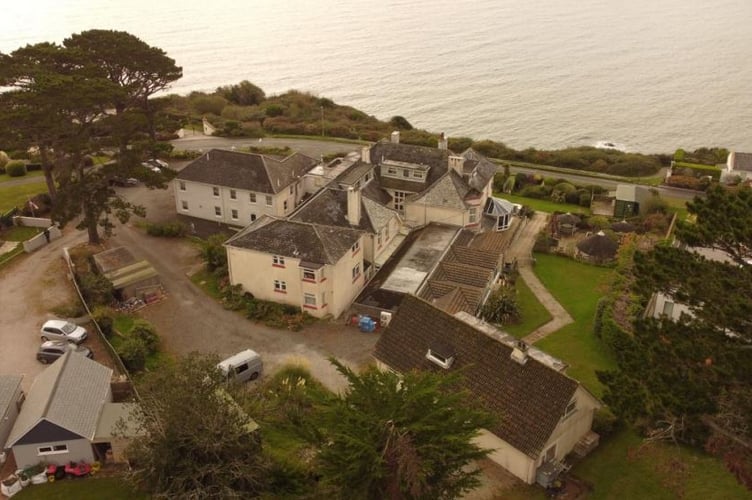
Hotel could become houses
PRE-application advice is being sought by developer Acorn Blue to demolish a clifftop hotel in Carlyon Bay, near St Austell, to be replaced with 18 homes and associated works.
If approved, the Porth Avallen hotel and detached managers’ accommodation would be pulled down to make way for the homes on 0.6 hectares of land on the northern side of Sea Road in Carlyon Bay.
A supporting statement says: “Although the hotel remains operational, its condition reflects years of limited capital investment, with incremental patch repairs (notably to the roof) and dated extensions, underlining the challenges of sustaining viable operations in the current market.”
A “high-quality residential scheme” has been conceived as a “landscape-informed redevelopment” that responds directly to the site’s distinctive coastal setting.
Vehicle access would be provided from the existing entrance on Sea Road. Based on the scheme as submitted, a policy-compliant level of 35 per cent off-site affordable housing contribution is assumed.
For more details see PA25/01175/PREAPP on the Cornwall Council planning portal.
Bodmin Jail plans met with concern
CORNWALL Council have said they have ‘significant concerns’ relating to proposals for the conversion of Grade II listed buildings and the construction of a gin distillery on land within the confines of the historic Bodmin Jail.
Bodmin Jail Distillery Ltd sought pre-application advice from Cornwall Council on the potential chances of the proposals it submitted for the change of use of existing buildings, namely the 1850’s built Governor’s House and the Chaplaincy in addition to the construction of a distillery in the grounds of Bodmin Jail, which was renovated from dereliction into an attraction and luxury hotel.
In the pre-application advice enquiry, the applicant stated: “The proposal forms part of the ongoing regeneration of Bodmin Jail—one of Cornwall’s most significant heritage landmarks—building on the success of the Bodmin Jail Hotel and Bodmin Jail Experience.
“The development aims to secure the long-term conservation and viable reuse of the Chaplaincy, Governor’s House, and listed boundary wall.
In the advice issued in response, it was stated: “Based on our site visit and assessment, the current proposals would result in harm to the listed buildings and their setting. This is principally from the loss of internal historic fabric and erosion of planform of the Governors House and Chaplaincy, particularly the removal of sections of the main dividing spine wall between the properties at lower ground and ground floor and fireplaces, and the extent of loss in the attic spaces.
“The subdivision and mixed use will require a suite of upgrades to meeting building regs including fire protection and compartmentation, acoustic upgrades and thermal upgrades. This can be quite impactful to historic buildings.
“The replacement of internal doors with fire doors and blocking up of original doorways would be harmful.
“The loss of visual legibility and integrity of the garden spaces and loss of original garden dividing wall, which currently form part of the setting of the listed buildings and their significance.
“The scale and design of the distillery building and side extensions, which would be readily viewed as expansive new additions from key viewpoints and would tend to obscure the architecture and presence of the Governors House and Chaplaincy.”
The historic planning officer listed a number of remedies that could assist in overcoming the concerns raised, including the retention of the existing planform and internal historic features within the building, respecting historic finishes, having a sensitivity in approach to upgrades following Historic England guidance documents.
Additionally, they called for any application to consider exploring the possibility of reduce the scale and footprint of the proposed distillery to better preserve the listing buildings’ setting, preserving key views to the heritage assets and to consider retaining the historic dividing garden wall and reducing the scale of the side extensions.
The officer added: “Any residual harm would be weighed again the public benefits in the assessment of the forthcoming application. We note that public access and the ability for greater appreciation of the heritage assets could be a public benefit. There are also opportunities for heritage gains such as the reinstatement of traditionally detailed windows, rainwater goods and railings where these have been lost, the removal of some late 20th century interventions e.g. polystyrene ceiling tiles, over boarding on doors etc.
“The suite of conservation focused repairs that will be required is also a conservation again. Historic building recording prior to adaption might be required and offers a form of mitigation but is not an equal substitute for preserving significance.”
Concluding, the planning officer added: “A new distillery attraction associated with the existing Bodmin Jail attraction in this location is considered supportable in principle. However, there are significant concerns with regard to the scale of the proposal and its impact on the surrounding heritage assets.
“Harm has been identified which in this instance is not considered justified and it is considered that the proposal be significantly reduced in scale. Additionally, there are concerns in terms of the re-ordering of the existing dwellings and the change in floor layout.”
Barn could become a house
A planning application seeking the conversion and extension of an existing barn to form a dwelling alongside the construction of a car port has been applied for in St Ive.
The application concerns land to the south east of Merrymeet Vineyard, St Ive.
For more details see PA25/08817.
- Keep up to date with the latest planning applications and other statutory notices (such as alcohol licensing and probates) that affect where you live by visiting our online Public Notice Portal – be the first to know by visiting www.publicnoticeportal.uk/cornish-times-series
Comments
We've recently changed our login process. If you have an account for commenting, you will need to re-register on the login window.
This article has no comments yet. Be the first to leave a comment.