
EACH week, hundreds of planning applications come before Cornwall Council’s planning department, seeking to win approval for various plans right across the Duchy.
These plans can comprise of a number of different reasonings – ranging from permission to replace windows or listed building consent ranging up to large house building developments or changing of use of a building, for instance, from an office to a café, or flats.
Within this large and often complex system, there are a number of formats from which planning advice and approval can be sought.
These range from full applications where all the details which comprise a proposed development or work to a building are submitted, to outline applications, where further details are yet to be confirmed, for example, an outline application with reserved matters for appearance may not confirm the final proposed development but rather seek permission in principle.




An example of this is one for an outline permission for 20 dwellings on land with reserved matters for appearance and scale; the reserved matters would require further permission later for their inclusion.
Other types of applications include pre-application advice requests, where would-be developers submit often outline proposals to a local authority to ascertain whether it is likely to gain support or not prior to submitting a planning application.
The vast majority of applications are decided by planning officers employed by a local authority under ‘delegated powers’, meaning they do so on behalf of their employer, however, some applications are ‘called in’ by local councillors to be discussed at an area’s strategic planning committee meeting, meaning the final decision rests with a committee of councillors.
New future for old offices
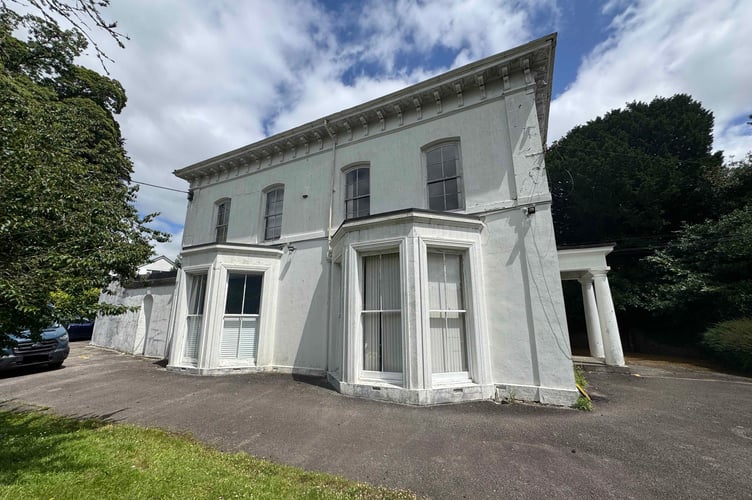
A PLANNING application seeking permission to change the use of a former office in a historic building in Liskeard has been submitted to Cornwall Council.
Mrs Jewell has submitted an application seeking approval to change the use of Graylands on Dean Street, Liskeard to a residential dwelling.
If approved, it would become a dwelling of four or more bedrooms – with the internal layout and external appearance of the Grade II listed building remaining intact.
Graylands has a long and storied past since its construction in 1855 to a stucco and masonry construction design by Mr Henry Rice and originally the residence of Mr Peter Clymo, who discovered copper at the South Caradon Mine in 1836.
The building had most recently been used by Caradon District Council and later Cornwall Council for the registration of births, deaths and marriages as well as being a venue for registry office weddings with the applicant for the planning permission stating that it had been empty for a number of years. It had been bought at an auction in late 2025, with a winning bid of £316,000.
The applicant’s planning agent stated: “As the proposal seeks to return the building to a dwelling without any internal or external alterations, it is considered that the development will have a positive impact upon the Grade II Listed Building, as well as the Conservation Area within which the site is located.”
The plans are viewable on the Cornwall Council planning portal under the reference PA26/01147.
Concerns over bus depot
A RETROSPECTIVE planning application for the use of part of a former garage as a bus depot has been met with objections by residents and Bodmin Town Council.
Stagecoach South West have recently taken over the garages to the rear of a building once used as a car dealership on Priory Road in the town.
A retrospective planning application seeks to regularise a planning change that has already taken place – in this instance, the site is already being used as a bus depot.
Previous to its redevelopment as retail and office units with the retention of servicing garages to the rear of the building, it had for many years been the site of Cummings car dealership and fuel station.
In the application, Stagecoach South West stated: “The Proposed Development seeks to enable the continued active use of the Site as a bus depot and providing essential transport services for Cornwall Council schools and local colleges. The depot functions as a base for school and college bus operations, with vehicles stored on-site overnight.
“The purpose of this application is to regularise the current use of the Site as a bus depot (Use Class Sui Generis), to reflect its established operational role. This permission will enable the continued occupation of the Site for transport related services. Formalising this use ensures that the Site remains in active employment, delivering a vital local service that supports Cornwall Council, educational institutions, and the wider community.”
However, the application has been met with objections from residents and Bodmin Town Council.
It has also seen the issuing of a noise abatement order by Cornwall Council’s public protection noise team, who said: “It was our opinion that the noise from the premises was unreasonably affecting neighbouring properties to the extent that they were causing a statutory nuisance under section 79 of the Environmental Protection Act 1990 and a noise abatement notice was issued on Stagecoach following an investigation.”
In a recent planning meeting, Bodmin Town Council decided to object to the application. In a proposal by Cllr Andy Coppin and seconded by Cllr Pete Skea, the town council observed: “Bodmin Town Council strongly objects to this application.
“The committee considers the proposal to be in direct conflict with Policies 13 and 16 of the Cornwall Local Plan.
“Under Policy 13 (Development Standards), the proposal fails to avoid adverse impacts arising from noise, odour, and pollution. The level of vehicle activity proposed, together with the operational characteristics of the site, would result in material harm to neighbouring residential properties.
“Under Policy 16 (Health and Wellbeing), the proposal fails to protect the community from an unhealthy environment and does not adequately mitigate health risks associated with air quality and noise pollution. The siting of this use in close proximity to sensitive residential receptors is fundamentally inappropriate and fails to safeguard residential amenity.
“Members expressed grave concerns regarding traffic safety and management. The projected level of activity, up to 123 two-way vehicle movements per day, would generate significant congestion. It was noted that double-decker buses already queue heavily along Prior Road, and the additional traffic burden would exacerbate this issue, with clear implications for highway safety and local network efficiency.
“Furthermore, the routine idling of diesel engines, coupled with the noise generated by buses manoeuvring and using the site’s access ramp, would create an unacceptable level of noise nuisance, unpleasant odours, and increased emissions immediately adjacent to residential dwellings. The cumulative impact would be harmful to living conditions and inconsistent with the principles of sustainable development.
“For these reasons, the Committee strongly objects to the application.”
Residents also objected to the proposals on similar grounds to the town council, citing specific examples of the disruption noise had caused.
The plans are viewable using reference PA26/00727 on the Cornwall Council planning portal.
Find out about planning applications that affect you by visiting the Public Notice Portal.
- Keep up to date with the latest planning applications and other statutory notices (such as alcohol licensing and probates) that affect where you live by visiting our online Public Notice Portal – be the first to know by visiting www.publicnoticeportal.uk/cornish-times-series
Comments
This article has no comments yet. Be the first to leave a comment.