
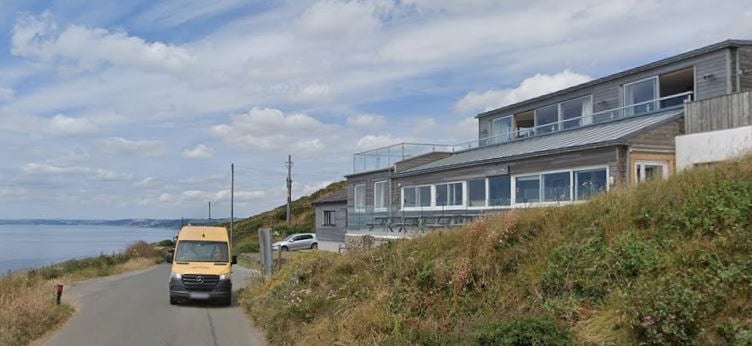
GROWING criticism at a planning decision to allow a popular Cornish clifftop restaurant to be turned into a private home has led to a government challenge.
It was reported recently that due to a planning “loophole” the owners of a restaurant formerly known as The View are able to convert what has been described as a “hidden gem” into a residential dwelling. The building is on Treninnow Cliff, near Millbrook.
The applicants applied for prior approval to make the changes under Class MA of the General Permitted Development Order meaning they did not need to submit a full planning application, which has caused dismay among the local community around Millbrook on the Rame Peninsula.
Many people believe the restaurant is a viable business and without it the economy of the area – as well as social cohesion – will be affected. They fear it could set a planning precedent and see other buildings on the protected stretch of coastline overlooking Whitsand Bay turned into homes and even Airbnbs and holiday lets.
.jpeg?width=209&height=140&crop=209:145,smart&quality=75)
.png?width=209&height=140&crop=209:145,smart&quality=75)

A Cornwall Council planning officer wrote to the area’s Labour councillor Kate Ewert admitting the decision is “likely not what you wanted to hear” and “I appreciate the upset that this application has caused locally”.
“However, because the application is for prior approval we can only consider whether the proposal meets the regulations or not. We do not have the opportunity for policy or subjective assessment as we do with planning applications.
“I note that both St John and Maker with Rame Parish Councils objected to the proposal. Applications for prior approval are not subject to the usual consultation and, as a result, the option to call to committee is not available.”
Cllr Ewert has said she is “hugely disappointed” by the decision of the planning officers. She said the Class MA permitted development ruling was brought in under the previous Conservative government in 2021 to try and speed things up following the Covid pandemic.
“It’s a policy that works really well in urban centres when they want to turn things over from non-functioning shops or restaurants into housing. It makes sense, but it doesn’t make sense in a rural communities,” she said.
“We’ve approached the MP [Anna Gelderd] and she is going to be raising a written Parliamentary question about it.”

Cllr Ewert claimed: “The business was bought and then not run as a viable business. It’s been there for years and it’s always been a viable business. You’ve got the Clifftop Café a few hundred metres along the cliff, where you have to queue up for a table it’s that viable.
“I want to know if there is any way around this. I’ve asked Cornwall Council’s chief planning officer to look at this again and she has agreed to because we’ve got an Article 4 directive on the cliffs, which means there is quite a lot of protection in terms of planning up there.
“She’s having a look to see if the wording of the Article 4 can perhaps change the decision and it might do. If we’ve got all those protections and you can just go around the system, what is the point of those protections?”
An Article 4 Direction is a tool used by local planning authorities in England to restrict “permitted development rights” in specific areas. It is designed to protect the character of conservation areas, the appearance of buildings or to prevent harmful changes of use, such as turning commercial properties into residential units.
Ms Gelderd said: “I’m raising this issue with the government. I’m calling on ministers to set out clearly how development rights of this type are affecting the retention of commercial premises in rural and coastal areas like ours here in South East Cornwall.
“I know we need more homes in this area so that our young people can live closer to where they grew up, but we must find practical solutions – not simply lose local restaurants like this one.”
There is a suggestion locally there is a covenant attached to the property which means if planning permission is granted for change of use of the restaurant element, including to residential use, then a payment of 90 per cent of the uplift in value of the proposed new use would be payable to Cornwall Council and Plymouth City Council.
Maker with Rame Parish Council objected to the change of use, telling Cornwall Council: “The View was a successful business prior to the new owners taking over, who have kept the business closed for extended periods and who offer a menu, when the premises is open, which may not be best suited to the area.
“If the business is being run to show a loss, which may be the case here, to justify changing the business to residential, it will fly in the face of genuine applications where there is a proper argument to change a business to residential.
“If this application is approved, it will make a mockery of the planning process as a whole and, in particular, of the previous applications which allowed residential accommodation to be granted where normally it would be refused based on the business need.”
Cornwall Council have been asked for a comment in response to Cllr Ewert’s approach to the authority’s chief planning officer.
The planning department has previously stressed that as it was an application for prior approval, local and national housing policies are not taken into account during the decision-making process.
Referring to concerns the decision could set a precedent, the council’s planning department said: “The granting of prior approval for a change of use does not set a precedent. As this is an application for prior approval, the usual requirements to demonstrate that the business is not viable are not applicable.”
Laurence Associates architectural practice, which submitted the proposal on behalf of the applicants, have also been asked to comment in response to concerns raised by the parish councils and residents, but have not responded at this time.
Comments
This article has no comments yet. Be the first to leave a comment.