
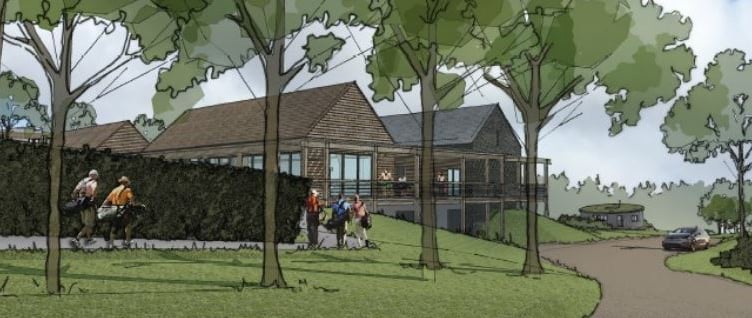
A PLANNING appeal against a proposal for a golf clubhouse and reception, 19 holiday lodges (aparthotel c1 use class), small classroom and new access and parking arrangements at a location near to the historic Restormel Castle has been dismissed by the planning inspector.
Mr A Smit appealed to the planning inspectorate seeking to overturn Cornwall Council’s decision to refuse planning permission for his proposals at Gillyflower Golf, Cott Road, Lostwithiel.
Two major issues in its refusal were identified, namely: the character of the surrounding Area of Great Landscape Value (the AGLV); and the significance of the Scheduled Monuments comprising Restormel Castle: motte, bailey and shell keep (Restormel Castle), and Roman fort, annexes and temporary camp, 290m south-west of Restormel Farm (the Roman fort and camp); the Grade II* Registered Park and Garden (RPG) known as Lanhydrock; the listed Battlefield relating to the Battle of Lostwithiel 21 August 1644 (the Battlefield); the Restormel medieval deer park; and the Lostwithiel Conservation Area (the CA); and whether it would preserve the setting of the Grade I listed Church of St Bartholomew.
The appeal to the planning inspectorate centred on reasons why in the view of the applicant, the decision to refuse was incorrect.




To overturn the appeal, it would have to be proven that there were material reasons as to why Cornwall Council’s decision to refuse the initial application was in error or contrary to its own planning rules and guidance.
However, the inspector said when weighing up the planning balance that the harm was on the lower end of the scale, stating: “I have found that there would be less than substantial harm caused by the proposed development to the significance of Restormel Castle, the RPG, the CA, and the Church of St Bartholomew, and that the levels of harm would be at the lower end of the scale.
“I have also found that there would be limited harm caused to the significance of the former deer park.
“However, I have also found that there would be a moderate adverse level of harm caused to the character of the AGLV (area of great landscape value), which would be in addition and residual to that harm relating to the second main issue concerning heritage assets.
“When combining that residual additional harm to the character of the AGLV with those albeit low or limited levels of harm to the significance of the HAs referred to above, the harm that would be caused by the proposed development would outweigh the benefits. Having regard to policy five of the Local Plan, I therefore also find there not to be an overriding locational and business need for the proposed development to be in that location.”
In conclusion, the inspector rejected the appeal stating: “ The proposal would conflict with the development plan as a whole and material considerations do not indicate a decision should be made other than in accordance with the development plan. For the reasons set out above, I conclude that the appeal should be dismissed.”
Comments
This article has no comments yet. Be the first to leave a comment.