

MP Sheryll Murray has responded to accusations that she has not “stepped up to the plate” to argue for fair funding for the Tamar Bridge and Torpoint Ferry.
Here, she explains her position, and provides some historic background on the crossings: how they were created, and have been funded.
It is important we look at the crossings of the Tamar, both of which are in public ownership, being owned and operated jointly by Cornwall Council and Plymouth City Councils. These Joint Authorities formed a special partnership in 1950 to lobby national government to fund a fixed crossing of the Tamar, but in the face of government inaction, decided in 1955 to go forward with the scheme themselves as a local enterprise financed from tolls.
The Tamar Bridge Act gained Royal Assent on 27th July 1957 and provided Parliamentary powers for the compulsory purchase of land, construction of towers in navigable waters, closure of existing roads and for them to subsequently charge tolls. The Act also created the Tamar Bridge and Torpoint Ferry Joint Committee, which was charged with the subsequent operation, maintenance and improvement of both the planned Tamar Bridge and the existing chain ferry operation at Torpoint.


.png?width=209&height=140&crop=209:145,smart&quality=75)
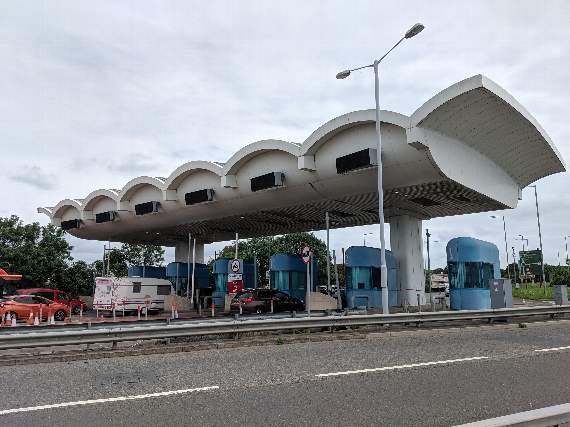
The Bridge was opened to the public on 24th October 1961, and since that time the Joint Committee has continued to operate and maintain the Tamar Bridge. Between 1998 and 2001 the Bridge underwent a major rejuvenation when it was both strengthened and widened. More recently, during 2006, the tolling function has been upgraded with a major refurbishment of the toll plaza, including a new canopy, and the introduction of electronic toll collection, together costing approximately £4.5 million.
The Bridge normally carries over 16 million vehicles a year – over ten times that carried in the early years, and on a busy weekday over 50,000 vehicles use the crossing.
The construction, operation, maintenance and improvement of the crossing have all been financed from toll income, and toll charges remain amongst the lowest for a major estuarial crossing in the UK.
The history of the Torpoint Ferry must also be considered in order to fully understand the relationship between the two crossings because there is often confusion concerning the way in which the tolling works.
Cornwall County Council acquired both the ferry and the steamers in 1922. Motor traffic using the route increased rapidly after World War II, and two new ferries with a capacity of 30 cars each were introduced by 1961. A third ferry entered service in 1966 and a marshalling area was built on the Torpoint foreshore, relieving congestion in the centre of Torpoint. The landing beaches were expanded further in 1972 allowing all three ferries to operate simultaneously. The three ferries were refitted in the 1980s and were stretched so that they could carry approximately 50 cars. These remained in service until 2005 when they were replaced by the current ferries.
The Tolls are currently set by application, making a business case to the Secretary of State under the terms of the Act, and the latest application was made in November 2019 and can be viewed at the following link: https://www.legislation.gov.uk/uksi/2019/1464/made
The issue of asking for the Government to fund the removal of the tolls was raised in 2017 in Cornwall Council, to which the Portfolio Holder said this is a matter for the MP. In the light of this suggestion and the fact that the crossings are owned by both authorities I wrote to the Council to get clarification on whether they would like me to approach the government.
The letter in response was quite clear, “Any proposal to seek the end of the tolls for the crossings of the Tamar would first need to be debated and supported by the Tamar Bridge and Torpoint Ferry Joint Committee and thereafter by Cornwall Council and Plymouth City Council. I am not aware of any item yet being submitted to either the Joint Committee or to the respective Councils.”
To the best of my knowledge this situation has not changed.
I have been made aware of the situation with regard the funding due to the drop in traffic which was compounded by the decision to remove the tolls entirely during the first lockdown.
I have approached the Secretary of State and indeed had a meeting with the Minister to discuss a change in the toll revision structure as set out in the Act of Parliament, particularly in view of the financial situation. After a telephone conversation with the Service Director - Transport and Infrastructure at Cornwall Council, I made a request to the Minister, based on his suggestion of a way forward. The Minister has written confirming that she is willing to look at this as a way forward
I will continue to do everything in my power to ensure that I make representations to Ministers on these important routes for many people in my constituency. It is disappointing that some are using these routes, upon which many of my constituents rely, as a political stick to bash the Government who has already provided around £444 million to Cornwall Council, including around £35 million for emergency funding for Covid related costs and around £6 million for Transport Links. A large amount of funding has also been given to Plymouth City Council.
It is very disappointing when we see a Council looking for staff for an office in Brussels when we have left the European Union yet they complain that they find difficulty here in Cornwall. But this, like the Tamar Crossings, is a matter for elected Councillors, certainly in the first instance.