

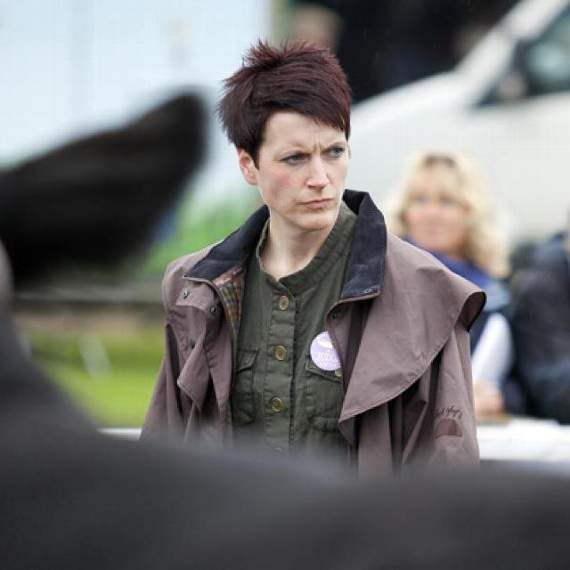
AFTER just a few moments talking to Gayle Bersey, I know three things about her: she works damn hard, she is passionate about British farming and especially, about native breeds – and she is a thoughtful and frank speaker on the things she believes in.
Farmer, breeder, and auctioneer’s clerk, she has decades of experience in showing and judging at national level under her belt.
We spoke to Gayle about the role of food in our lives, misconceptions about farming and the environment, the importance of the livestock markets, and how our British breeds could play a key role in a sustainable future.
Gayle, 46, is the fifth generation of Berseys farming near Polbathic. Retirement of her parents Nick and Marie due to ill health in 1994 led to Gayle starting the Lyhner Valley Aberdeen Angus herd. At 19 and knowing that the farm in its entirety would be too much to manage, she kept 30 acres of the land to raise a modest number of pedigree cattle as well as a small flock of Hampshire Down sheep. Through selling cattle for store, and the occasional sale of bulls and heifers for breeding, the farm pays its keep.
.jpg?width=209&height=140&crop=209:145,smart&quality=75)
In addition Gayle works at a local poultry farm one day a week, milks on another neighbouring farm several times a week, and devotes the bulk of two days to her work as secretary for the Hampshire Down Sheep Breeders Association.
She is employed as an auctioneer’s clerk for Kivells at Hallworthy Market on a Thursday, and Fridays is for Exeter Market.
Gayle is a big fan of the livestock markets. “I really like meeting the people. Farming can be quite a lonely job and markets are a really good way to keep connected. Plus they’re a good way to stay up to date with prices. If you sell privately, how would you know what someone is prepared to pay?”
Days in the Bersey household typically begin at 5am and end, on a milking day, after dusk. It’s a tough routine, and while Gayle is passionate about supporting young people into the industry, equally, she would never be anything than honest about the reality of the job, with its long hours and ‘rubbishy pay’. “Money is definitely the biggest barrier for young people going into farming,” she says.
She’s been named Cornwall Farming Business “Best Woman in Farming” and in 2018, was the subject of a feature in the Daily Express about the nation’s growing cohort of ‘soil sisters’. Gayle has mixed feelings on this.
“All I want is to be seen as a good farmer – not as a good woman farmer,” she explains.
“To give you a similar example, my daughter is very into horseracing and has followed Rachael Blackmore (who in 2021 became the first female jockey to win the Grand National).
“The thing is, she’s a brilliant jockey, not a brilliant female jockey.”
There’s a history of women in the Bersey family participating in all aspects of the farm labour, says Gayle – and so it is something that has always been accepted as normal in her world.
“My dad’s sister was always allowed to work at home and my great auntie always did too, so it wasn’t something particularly unusual for me,” she says.
“But I do remember quite a few women of my age group were not encouraged to work at home, they were encouraged either to find ‘a better career’ or get a husband.”
Gayle says that to be taken seriously as a woman in farming “you do have to be prepared to put in the same hours as the men” and concedes that this can be hard to juggle with motherhood. She would hope, now, that her competence and success speak for themselves.
“I’ve worked in the livestock markets for the last 26 years and showing my cattle, hopefully seeing me out and about and talking to me, other farmers just treat me as one of them.
“I’ve had so many opportunities through keeping pedigree cattle. You get to show, you get to judge all over the country. I’ve been to Smithfield and the Royal, and have judged at the Royal Highland and in Ireland. I’ve been very lucky.”
Her decade as youth co-ordinator for the Aberdeen Angus Cattle Society (AACS) has been one of the most enjoyable highlights of her working life, both for the reward of helping young people get a start in the industry and for the travel opportunities.
“Ten year ago, the stockmen skills were dying out, so it is really good to see more young people getting involved in showing and breeding.
“But there is more of a gulf now, between the agricultural community and the general public, I feel.
“We had a speaker once at one of our conferences and he put it quite well – he said that 30 or 40 years ago there wasn’t such a big gap between town and country because more people worked on farms which meant more connections in the surrounding community. Now though, there’s less labour on farms and so there’s less of a connection.”
For young people that don’t have a family background in farming specially, it can be a huge leap of faith to go into the industry but “if people really do have that passion they’ll find a way to do it” says Gayle, and organisations such as the AACS are there to guide young people in. Gayle is a huge advocate for healthy, British grown and produced food. As the global conversation focuses on climate change and reducing carbon emissions, she feels that farmers in the UK get an unfairly bad press.
“The focus seems to be on farmers to change what they’re doing. We don’t see the same media pressure on other massive industries. It seems to be easier to make farmers a scapegoat than to ask people to take fewer flights or drive around less,” she says.
“Farming is massively misrepresented. What people don’t realise is that there’s a big difference between the huge farms in America and the mixed farms here in the UK. Grassland is good at soaking up CO2. Veganuary has a lot to answer for – eating avocados from abroad you are causing more carbon emissions than by eating British beef. And if we all go to a plant-based diet, the fields would be dug up and sprayed.”
Farms here in South East Cornwall are often good, biodiverse habitats, she argues.
“I walk around the farms I work on and there is a lot of wildlife: flowers, bees, butterflies, and birds,” she says.
“Where you get something very dominant it throws things out of sync. Respecting nature in farming is all about balance.”
Native breeds such as the Aberdeen Angus have a lot to offer in terms of being more environmentally sustainable, says Gayle – and to farming without subsidies.
“These cattle use grass to its best advantage, you can winter them outside, and finish them naturally. I don’t have to buy too much corn.
“But our grading system for beef and lamb is currently more suited on the whole to the more muscled, continental breeds, which need a lot more grain and like to be inside more. You may take a small cut in the grades with native breeds but they are catching up.”
Gayle would like to see the agricultural sector promoted and celebrated here in the mainland UK as it is in Northern Ireland.
“Supermarkets here are quite good at promoting British produce, but you fly into Belfast and everything on every screen is about Irish agriculture, the billboards are about dairy and Irish produce. You wouldn’t get that at Heathrow.”
She would also like to see more education on agriculture and food, so that people’s approach towards food changes – and says in part that it’s down to the bodies that represent farmers to be proactive and “go into schools and talk about farming”.
“I think people need to look at more local, sustainable food, but it is tricky.
“The people using the farm shops are generally on higher incomes.
“If you’re on a lower income you probably can’t afford to care whether your chicken was in a cage.
“But equally, the proportion of our household budget we spend on food has dropped, with something like 20% being spent on leisure but only 8% on food.
“It starts in schools. They don’t really do home ec any more, children aren’t taught the value of food, so generally people spend as little as possible on food and as little time as possible cooking it.
“It’ll take a while to change the mindset of the public.”