

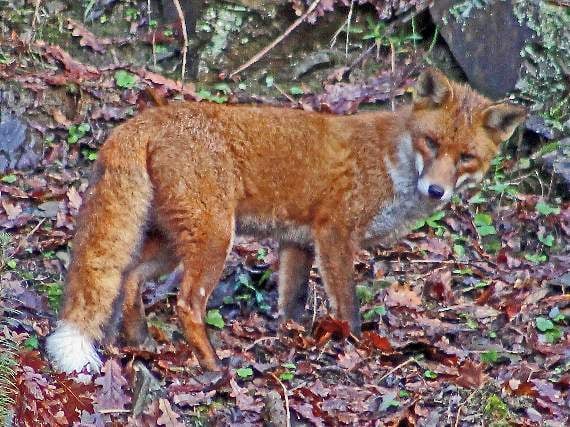
In this week’s Nature Watch feature, photographer Ray Roberts observes a wild fox on patrol and reminds us of our wonderful native wildlife.....
It makes me upset when I watch an advert on television that asks people to send two or three quid a month to help save apes, hippos or tigers that roam the African plains, whilst we in this country, hunt, shoot or cull foxes and badgers. I wonder how many children have actually seen either of these animals in the wild? They are a beautiful sight for anyone to observe.
Foxes are like oak trees – native to Britain since Prehistoric Times. They hunt mostly at night catching rats, squirrels, mice, voles and any frogs or toads they come across, but their main targets are rabbits that they can carry back to their earth, or den, to feed up to half a dozen cubs.
On the road hedges around what used to be the parish vicarage, there are still lots of pink purslane - Montia sibirica – five petalled flowers still out in bloom. This is another plant that was brought over from America some hundreds of years ago.




As always when I come to a path-field on my walk that has been planted with crops, I always walk stile to stile beside the hedgerow to avoid trampling what is growing. Last Friday I came to a path-field where winter barley was growing so I started walking tight to the hedge and noticed, growing among the brambles was a single yellow bloom.
It was a lesser celandine – Ranunculus ficaria – which, as most people know is one of the earliest wild flowers to bloom in the spring. Poet William Wordsworth so admired the flower that he wrote a poem, the first line of which is; There is a flower, the lesser Celandine. In fact, I think he wrote a couple more poems about what must have been his favourite flower.
Back on the road towards Trehunist I found another yellow flower on the hedge. This one was a creeping cinquefoil – Potentilla reptans – which was unusual as I have not seen it growing on a hedge before, usually they occupy grassland, especially on moorland. The plant spreads as the roots send up stringy runners that are pinned to the ground by clusters of fine roots at each leaf node and are called a weed when they grow in the garden.
There are lots of hogweed – Heracleum sphondylium – flowers appearing on the hedges and waste ground and most of them have their tiny white umbels tinged with pink making them look very pretty. The plant is so named as it was once collected as fodder for pigs.
I saw a garden spider sitting patiently in its web waiting for a fly, a bee or any other small insect to come along. I thought; good luck to you.
Fungi footnote. I saw a lovely little yellow fungus growing among the mossy hedge on North Hill that leads out of the village towards St Ive. I think it was calocera viscosa with its small branches resembling tuning forks, were about 3cm long and they certainly brightened up the hedgerow.