
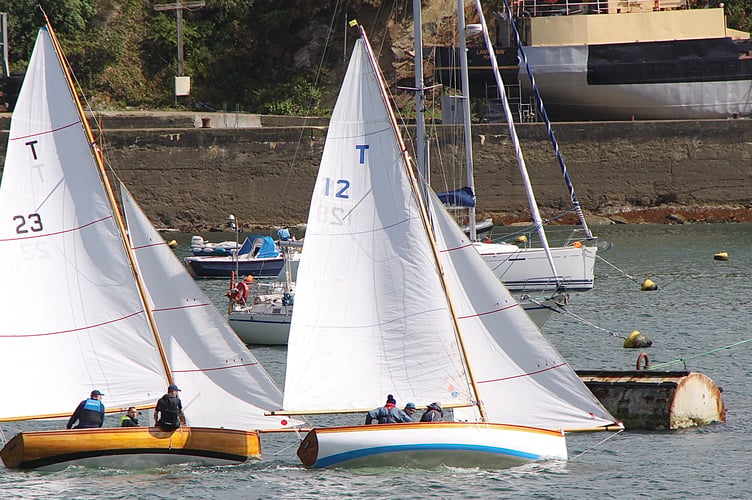
AN example of a class of yacht which was once synonymous with Fowey has won a trophy in the Classic Boat award for the standard of her restoration after being rescued from the Outer Hebrides by a boat builder based in Polruan.
The Troy Class yacht is named ‘Barbara’ – and the Cornish Times was contacted about the award presented to boatbuilder Marcus Lewis by the original Barbara after whom the vessel was named on the day of her birth, January 20, 1947.
Barbara Astra nee Bate - who was brought up in Fowey and Polruan but now lives in Stevenage, Hertfordshire – was very jubilant and emotional when she got in touch with us. Just the evening before she had watched an online streaming of the Classic Boat Awards taking place in London and had seen Marcus take the award for Restored Sailing Vessel Under 40ft for the work he had done on ‘Barbara’.
She explained to us that on the day she was born her father, Arthur Bate, had been meant to put some money down on a house, but instead he spent it on having the keel laid down for a new Troy Boat which he named after herself, his new daughter. She added that while she didn’t know how her mother reacted when her father brought home this news, she did know that she had her first sailing trip on board her namesake boat when she was aged just six months.

Troy Class Yachts had been built in Fowey since 1929, the first having been built as a one-off by local boatbuilder Archie Watty as Sir Charles Hanson, from Fowey Hall, had wanted a boat for his daughter to race competitively. Archie designed and started building an 18ft boat, with a lead keel, in the winter of 1928. During construction, the local bank manager, Mr Strong, called in and was so impressed with the design that he immediately ordered one for himself. Both of these boats were on the water for the 1929 sailing season and performed very well. So well infact, that four other competitors from the dinghy fleet ordered new boats to the same design for the next year.
When we got in touch with Marcus Lewis he told us that Troy Class Yacht number 12, named ‘Barbara’, was ordered from A.H. Watty in January 1947, by Polruan builder Arthur Bate. He confirmed the story that Arthur ordered her on the day his daughter, Barbara, was born, when he was meant to be putting a deposit on a house for his family!
Marcus said that Arthur Bate raced T12 ‘Barbara’ for the next few years, improving his results dramatically, and was very successful in ‘Barbara’ in 1951, ‘52, and ‘53. Sadly, he moved away from Polruan in 1953, selling the boat to a Mrs Gilchrist, whose Christian name was appropriately also Barbara.
Mrs Gilchrist owned ‘Barbara’ for four years, before selling her to Miss N Bradbury of Polruan in 1957. When Miss Bradbury put ‘Barbara’ up for sale in 1958, the Troy Class yacht was bought by Commander Campbell and taken to Padstow, on the River Camel. From there she was eventually taken to Scotland after Cmdr Campbell sadly died while ‘Barbara’ was undergoing repairs.
Marcus said that the Troy Fleet in Fowey, like many other local one-design fleets around the country, had its ups and downs in popularity, with some fleets disappearing completely. Several boats were taken away from Fowey over the years but then 1980s saw a resurgence of interest, with Troy No 16 coming back from Southampton, and several boats changing hands to keen new crews.
Marcus said: “Richard Kitson and myself decided to try tracing the four boats that were out of port, and this led to finding Troy No 3 ‘Janet’, and bringing her back to Fowey to race. It was at a re-launching ceremony for Janet in 1984 that Radio Cornwall Interviewed Richard Kitson and put out an appeal for Information on the three other missing boats, Numbers 2, 8 and 12. It was subsequently found that Nos 2 and 8 had been broken up, and no longer exist in any form, but it was through this appeal that T12 ‘Barbara’ was tracked to the Outer Hebrides, and on contacting the owner, we discovered she had foundered on her mooring in a storm some years previously, and had been hauled out onto the beach and left.
“We contacted the current owner, obtained some pictures, and passed the details to Barbara’s original owner, Arthur Bate, in 1985.”
It turned out that Barbara had ended up on the little island of Flodaigh, which is a tidal island lying to the north of Benbecula and south of Grimsay in the Outer Hebrides. It is connected by a causeway to Benbecula – the island on which Highland heroine Flora Macdonald was visiting relatives in June 1746 when she famously carried out a boat rescue of Bonnie Prince Charlie ‘over the sea to Skye’ after his failed bid to take the throne for the House of Stuart in the Jacobite rebellion of 1745-46. He was subsequently able to take a ship to safety in France and ended his days living in Rome. Flora, meanwhile, was arrested and spent a few years in the Tower of London before being pardoned and released. Some 30 years later she again unsuccessfully backed a royal cause - this time rallying forces for the Hanoverian British monarchy after emigrating to North Carolina during the American Revolution that founded the United States. She eventually returned to the Hebrides, with her and her husband losing their property in America.
Returning to the modern day and ‘Barbara’s’ situation in the Outer Hebrides, Marcus says that it was clear that another boat rescue was now needed. He recalls: “Sadly, after five or six years of trying, Arthur Bate gave up trying to rescue ‘Barbara’ and sort of handed the job back to us. I asked my partner, Sue, if she fancied a trip to the Outer Hebrides. So in 1990 we went and found her, and discovered that time hadn’t been kind to Barbara, and had deteriorated badly.
“To rescue Barbara would involve a few challenges. She had to be floated around the island to the causeway, and pulled out of the water. She was in no state to float. She also wasn’t in a fit state to sit on a trailer for a 700-mile journey, etc, etc.
“The more you thought about it, the worse it got! However, after talking to people around Fowey, Major Tony Parkyn suggested Army landing craft from Marchwood could pick her up and bring her back in the autumn, if we could to get her 10 miles to a jetty.
“So in the autumn of 1990 we headed up there again, Richard Kitson, Sue, and myself, and managed to strap oil drums around her, nail her together, and float her around the island to the causeway, where we pull her ashore in the dark, propped her up, and hoped she was still upright in the morning...
“The next morning she was high and dry and still upright. So we took off all the oil drums and so on and winched her up the slope onto the roadway. It was a bit of a struggle, but we made it, and left her there for the RAF to collect in a day or so.
“We had arranged with the RAF base on Benbecula that they would kindly pick her up and carry her to the jetty where she waited for the Army supply ship.
“But when we arrived back in Fowey we were told the ship’s captain deemed ‘Barbara’ too fragile to carry, and she would need to be crated up properly… something that was impossible to do until the following year. So it was a bit of a surprise a week or so later when the ship arrived in Fowey carrying ‘Barbara’. It was also a suprise when we saw her in the hold. She had broken into three pieces on loading aboard the ship!
“It was really disappointing to see ‘Barbara’ in three pieces, each piece on a separate pallet, so the next day we started disassembling the wreckage, keeping the main centreline timbers – and, of course the 16cwt Lead keel.
“This was in 1990, and the keel was put away, the main timbers were stored in a friend’s barn, with the intention of rebuilding one day when space and time and money all coincided.
“Fast-forward to 2015 and I had moved to a larger workshop, and had three or four quiet weeks in August, so work began on cutting new oak pieces for the centreline, and setting them up on the lead keel, and the temporary building moulds fixed in place.
“Over the next five years, there wasn’t the opportunity to spend much time on the rebuild. A couple of planks were fitted but that was about it. When COVID lockdown hit in March 2020, work on customers’ boats came to a dead halt, and no-one was really sure what as going to happen, but the second day of lockdown saw me start again on Barbara.
“Managing to do the majority of the work on the hull alone, but with some help from socially distanced friends when it came to riveting the nails, work carried on through the lockdown period, and then was continued alongside customers’ work over the winter. Then the middle of May 2021 saw her relaunched, re-rigged and racing again in Fowey Harbour - just what she was built for!”
So now ‘Barbara’ can once again be seen riding on the crest of a wave with other Troy Class yachts after her own rescue from the Hebrides and triumph at the Classic Boat Awards.
Comments
This article has no comments yet. Be the first to leave a comment.