

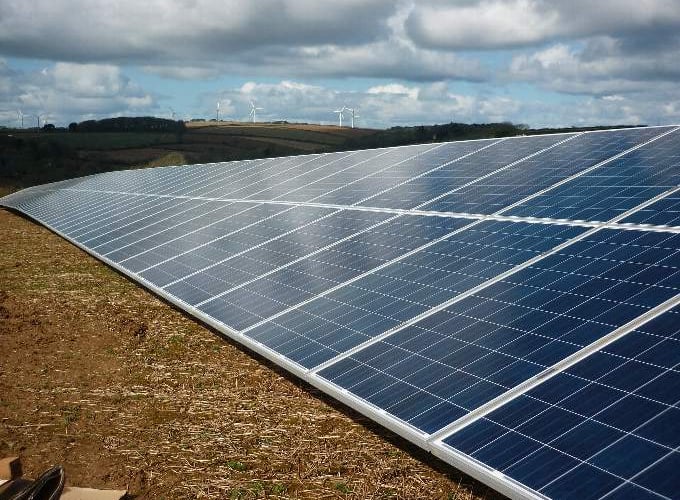
Almost 1000 acres of Cornish farmland could be taken out of food production and lose its valuable role in carbon capture if plans for four large-scale solar farms go ahead, says Cornwall CPRE.
The Campaign for the Protection of Rural England has hit out at a series of forthcoming proposals to create solar arrays on agricultural land in the county. The schemes in mid and west Cornwall are currently under consultation.
The charity is concerned that thousands of acres of farmland in the South West are set to go “from grass to glass” as solar farm applications come thick and fast.
Cornwall CPRE Chairman Richard Stubbs said: “All these proposals are for industrial-sized solar arrays in open countryside, protected by steel fencing and security cameras. Their technical maximum performance bears little relation to their actual output.”




The fast pace of construction of such solar farms is being driven almost entirely by subsidies from national government, states the CPRE; little or no benefit is returned to the local economy.
“In the case of two of the latest proposals in Cornwall, the profits will go straight back to the Norwegian government,” says Mr Stubbs.
Cornwall CPRE’s campaign against the march of the solar panels is being launched following Cornwall Council’s refusal last year to grant permission for a solar farm at Tregorrick near St Austell. At the time, Richard Stubbs said: “All credit to the councillors who gave just recognition to the value of Cornwall’s precious landscapes by refusing a wholly inappropriate industrial development slap bang in the middle of open countryside. “Cornwall CPRE welcomes this decision, which we believe creates a precedent for similar applications to build solar farms on productive farmland.”
The CPRE claims that the benefits of becoming more self-sufficient in food production, and reducing the amount of food miles that create CO2 emissions, are more important than the green energy aspect when considering whether to use productive farmland for solar panels.
Richard Stubbs said: “The issue here (at Tregorrick) is not renewable energy. This was the wrong location for a solar farm. Why waste high-grade farmland that could be used to produce food? In the long term, it’s far more sustainable to increase our self-sufficiency in food production.
“There are plenty of brownfield sites and industrial areas in Cornwall where ground or roof-mounted solar panels could be installed.”
What’s your view on the solar energy question? Send your thoughts to [email protected]