

Photographer Ray Roberts spots the St George’s mushroom on time for once this year.....
Usually the lovely spring mushroom named for St George, the Tricholoma gambosum, appears on pasture land, on roadsides and along the edges of woodland - a couple of weeks after St George’s Day itself. They have dirty white, almost creamy coloured caps and gills that are pure white unlike the field mushroom that has white caps and pink gills.
During the second world war the government produced a leaflet advising people, who were struggling to get food, to find the St George’s mushrooms and eat them. They have what can only be described as a strong ‘mealy’ smell but are delicious in soufflés or even just fried with bacon and eggs.
Walking alongside a small stream that trickled down to the River Tiddy I came across a large patch of opposite-leaved golden saxifrage – Chrysosplenium oppositifolium – that covered the bank going right down to the water’s edge. They have tiny yellow flowers between their almost circular green leaves.



There were lots of wood sorrel – Oxalis acetosella – flowers on a grassy bank down by the stream with their leaflets that fold down at night. Indeed, the whole plant reacts to light as the dainty white blooms that are lilac-veined only open fully in bright sunlight. When I worked as a builder and the site was out in the countryside, I would seek out these plants and add a couple of leaves to my cheese sandwich at lunchtime. Delicious they were too.
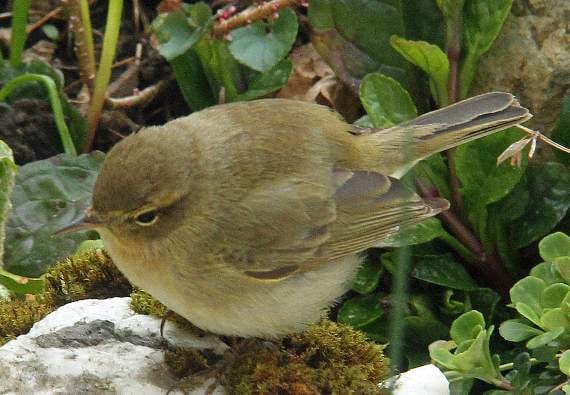
A small wren-sized bird was hopping around the scrubby vegetation and looking closely I could see it was a juvenile goldcrest that was too young to have acquired the familiar golden crest on its head. This youngster was obviously looking for small insects and spiders to eat. You don’t see many of these birds on a day’s march.
A peacock butterfly was flitting along the hedgerow and finally settled on some dry leaves. These butterflies come out of hibernation during March early April and this one seemed to be having a good look around whilst searching for buddleia or thistle flowers, although I think it was being a bit optimistic this early in the year.
Jack-by-the-hedge or garlic mustard – Alliaria petiolata – grows up to a metre high with a leafy stalk topped by a group of white, four petalled flowers. Crush the leaves and you will be able to tell why the plant is called garlic mustard, in fact it is the only member of the cabbage family that smells of garlic. I have never been a garlic fan but these leaves can be used in salads and I came across a short stemmed plant growing half way up the hedgerow and standing out well with just three flowers on it.