

A three-mile walk locally yields many interesting sights for photographer Ray Roberts....
I decided on a walk starting at the village and going downhill to Hepwell Bridge and then taking the narrow lane up to Trehunist, giving me an almost level walk back to Quethiock.
Beneath the bridge the River Tiddy was running fast, wide and brown, quite a contrast to the summer months when it narrows to a steady trickle as it meanders its way down through many turns and twists to Tideford, where, as the village name suggests, it is the last place the river can be forded, or walked across, before it widens out and becomes tidal and joins the River Lynher.
After the downhill jaunt to the bridge, I took the almost level lane towards Trehunist and had to walk through a couple of inches of flood water half a dozen times before arriving at the ford, where a brown stream of water rushed across the road. Luckily, the large granite gatepost that had been laid down as a bridge for walkers was still above the stream.




Some furze or gorse – Ulex europaeus – bushes were spread out along the hedgerow and despite their very, very prickly flowering stems, gorse is a member of the pea family. Mainly, it is a bush that inhabits moorland where its yellow flowers brighten up the landscape for most of the year. In fact, there is an old country saying that, ‘when furze is not in bloom, kissing is out of fashion’.
Some stinking hellebore – Helleborus foetidus – was growing on a hedge near Trehunist. This is a plant that is very aptly named as its green cup shaped flowers actually stink and its leaves, when crushed, smell even worse. However, there is a reason for this as the ‘scent’ attracts the early flying bees, because this poisonous plant is one of the first to bloom in the new year.
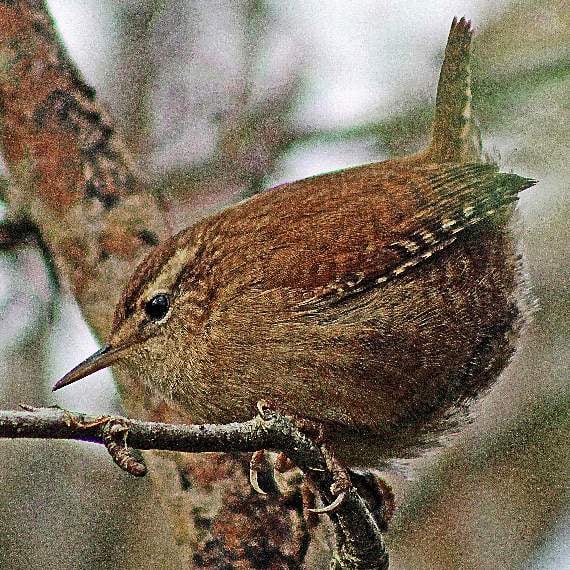
I noticed movement in the hedge creep so I stopped walking and spotted a tiny wren searching through the vegetation for insects. After a while it flew up onto a thin branch and posed for a photograph showing me its plump body with a short, stubby, almost vertical tail. The wren is our second smallest bird after the goldcrest and its cousin, the firecrest.
I was surprised to find some fool’s parsley – Aethusa cynapium – with its white flowers growing at the bottom of the hedge. This poisonous member of the Umbelliferae family usually finishes flowering during October and should never be confused with the cultivated parsley that we eat from the garden.
A pair of ladies wellington boots were hanging in a tree beside the gateway to some buildings. They must have been put up there to dry out but surely, I thought, as soon as they were dry another shower of rain would come along and drench them again.
Fungi footnote. Growing on the dead stems of brambles alongside the road near the village cemetery were lots of small white Lachnellula subtillissima bracket fungi. They usually grow on the twigs of pine trees and I picked the brambles out from the back of the hedges and stuck them into the roadside dirt to make them easily visible so other walkers could also enjoy seeing them.