

I CAME across some blue flowers beside the road over near Treweese Cross, they were growing right in among some brambles, too far away to touch so I used a telephoto lens to photograph them, writes Ray Roberts.
They were common lungwort blooms with five petals and their leaves were covered with white spots which, back in our forefathers’ days, were thought to resemble the lungs of miners so they decided this may be a sign that the plant could be used to treat lung diseases.
They were brought over from central Europe and because the flowers are pink at first before turning blue, they were given double names – Adam and Eve, and Joseph and Mary.
There is an old, short lane near the crossroads that was used by horse-drawn carts and wagons probably a hundred years ago.



This lane is no good for any traffic, either horse or tractor nowadays, but still a nice track to walk on.
I walked up it last week and found several Jew’s ear fungus growing on the trunk of a dead elder tree.
This fungus was named after Judas Iscariot, who supposedly hanged himself on an elder tree after betraying Jesus, and the brown, jelly-like, ear-shaped mushrooms serve as a reminder of this act some 2,000 years ago.
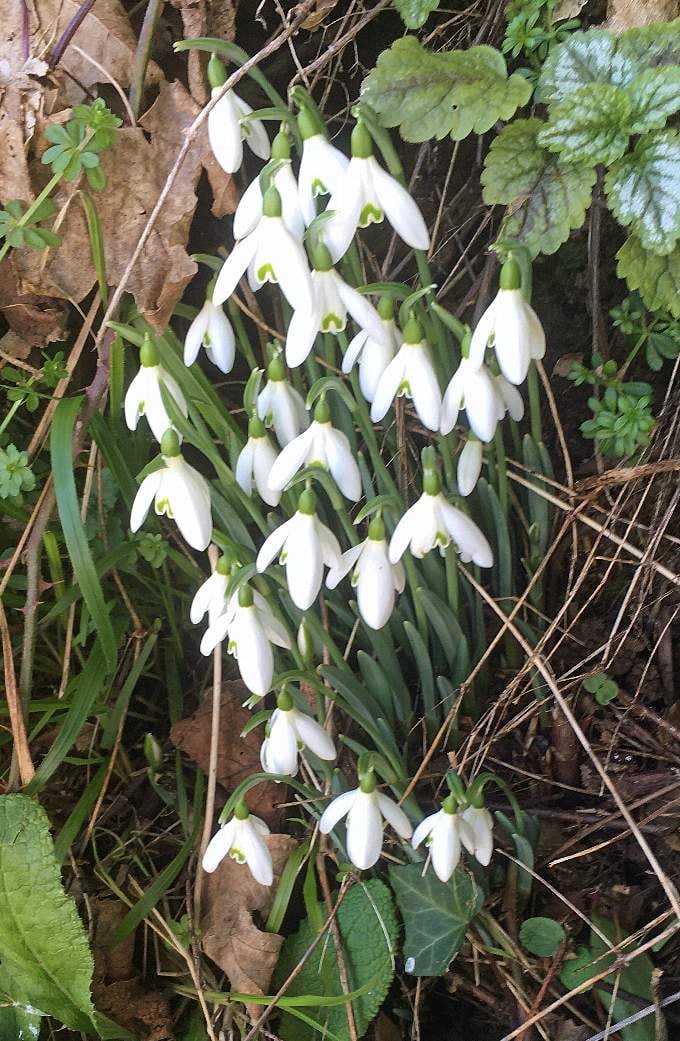
There were several red campion flowers in the lane and high up on one of the hedges were some snowdrops out in bud.
In fact, there are several of these lovely white spring flowers around the village.
I think we are lucky down here in the South West as they appear a lot earlier than they do in the rest of the country.
Ask anyone what colour moss is and the answer will always be ‘green’.
However, growing in the fork of a dead tree was some moss that was pinkish/orange.
I thought at first that it must be dead moss but it was still attached by its roots to the wood. Never seen anything like this before.
Hazel trees are beginning to show their flowers in the shape of long catkins.
These are the male flowers of the tree and the female blooms are tiny red flowers that will appear later in the year. Pollen from the catkins is blown by the wind onto the female flowers which will, in the summer, produce the lovely hazelnut for mice, squirrels and us to eat.
We have a variety of wild birds visiting our garden for food and a couple of days ago a long-tailed tit arrived and started to eat from one of the fat containers.
It’s easy to see how this small bird, that only visits a couple of times a year, got its name as its tail is longer than its body.