

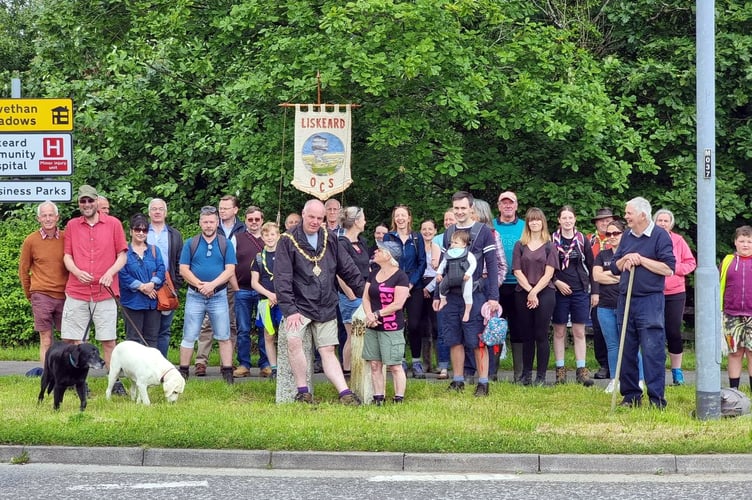
The ancient tradition of the Beating of the Bounds will be held in Liskeard this May.
The Beating the Bounds is an ancient Anglo-Saxon custom which is still observed in some English and Welsh parishes. It traditionally involves the tapping of boundary markers between parishes. A group of members of the community would walk along the boundaries of the parish to share knowledge of where the boundaries lay.
This walk will take residents along the boundaries of Liskeard.
In the Royal Charter of 1587 by Queen Elizabeth I, the bounds of the Borough, which continued to the present century, were fixed. This enclosed an area of 2704 acres and is nearly square, the distance around is approximately 10 miles.

There are a number of granite stones, marked B (Borough) and P (Parish). At present there is not an exact record of them all.
Liskeard Town Council are inviting anyone who would like to attend to meet at the Boundary stone opposite B & M at 10.30am on May 14.
The schedule of events are as follows:
Stage 1 – 10.30am
Begins with the traditional Bumping of the Mayor at the milestone adjacent to Morrisons Roundabout
Stage 2 - 10.45 am - 11.00 am
Maudlin to Bodgara Mill
On to Hendra Bridge
Stage 3 - 11.15 am - 12.30 pm
Hendra Bridge to Craddock Ford
On to Tremabe Bridge
From Craddock Ford to Treworgey Manor is all wheel chair, buggy friendly and takes approximately 45 minutes.
Stage 4 - 12.30 pm -12.45 pm
Tremabe Bridge
On to Treworgey Manor
1.15 pm - 2.30 pm
Lunch at Treworgey Manor
Stage 5 - 2.30 pm - 3.00 pm
Treworgey to Looe Mills
On to Lodge Hill
Stage 6 - 3.15 pm - 3.45 pm
Looe Mills to bottom of Lodge Hill
On to finish
Stage 7 - Lodge Hill to finish approximately 4.30 pm - 5.00 pm
Times are very approximate depending on the ability of the walkers.
Points of interest en route:
Maudlin
Site of St Mary Magdalin Chapel and Lazar House (for Lepers) at “Maudlin”. There are recorded burials in the Parish Register from 1553 to 1645. It was later a Toll Gate House on the Turnpike Road. Here is the first boundary stone (moved to make way for the By-Pass), when traditionally the first “Bumping” takes Place.
Bodgara Mill
Noted in all the Charters as the “Town Mill” used for grinding everybody’s corn. Several old millstones are preserved.
Stony Bridge (Stoney)
An old bridge first mentioned in 1609.
Craddock (Craddoc) Ford
Has now been replaced by the bridge over the Pensilva Road – where the boundary leaves the Seaton River.
The Clymo brothers, brought up from Charlestown to work at the Cornwall Great United Mines which redeveloped into the Phoenix Mine in the 1850s by the engineer William West, found copper in land owned by the Norris family of Rosecraddock. The Norris family owned much of the Caradon Hill and moors.
Soon after Old Treworgey Farm is the entrance to Treworgey Manor part of the Connock Estate. J Connock was Mayor in 1573 and 1581 and a great benefactor to Liskeard.
Lestitha Well
(Where the boundary joins the East Looe River) is reached over fields and the route returns to the Cross-Roads, formerly marked by a stone post labelled ‘canal’.
Looe (Lowe) Mills
Another Town Mill until about 1700. The Looe River was known as “Lowe Water”. There was another Toll Gate House.
Lodge Hill
The route leaves the Looe River and rises to cross the Looe Railway twice, passing under Liskeard viaduct and so over the By-Pass back to Maudlin.
(Notes compiled by Liskeard Old Cornwall Society and Liskeard Town Archivist)
Anyone is invited to attend this free event, you can do all or part of the walk. The section from Craddock Ford (half way through stage 3) to Treworgey is wheelchair and buggy friendly.
It is advised to bring suitable clothing and footwear and bring sun cream, a packed lunch and plenty of drinking water.
A spokesperson said: “Participants walk at their own risk. All children under 16 must be accompanied by an adult. Dogs on leads are welcome.
“If photographs are taken of other people’s property on the walk please respect their privacy and keep them for your personal use – don’t put them on Facebook or into the public domain.”
Comments
This article has no comments yet. Be the first to leave a comment.