

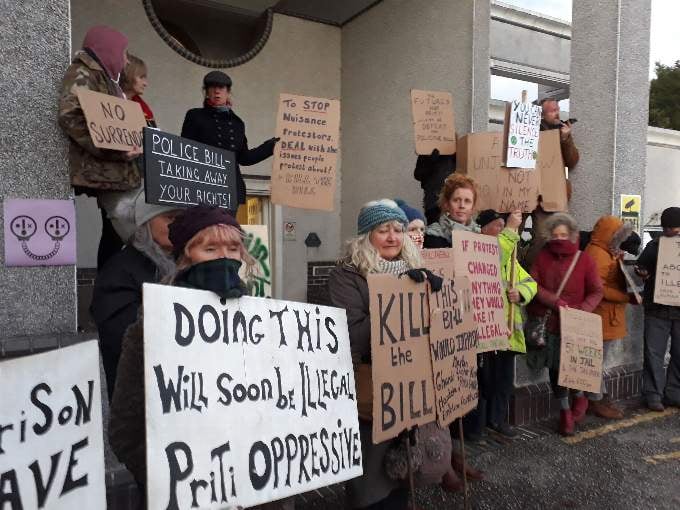
Cornish campaigners came together outside Truro’s courthouse to draw attention to the Police, Crime, Sentencing and Courts Bill, which was being reviewed by the House of Lords this week.
Those protesting are worried that the Bill, if it becomes law, will significantly limit people’s rights to protest, as well as having unintended negative consequences for homeless people and anyone wanting access to the countryside.
The campaigners also claim that the Bill is being ‘rushed through’ Parliament without enough time for MPs or the House of Lords to properly scrutinise it.
Antonia Pickup, who organised the protest, is concerned that the Bill is so broad and ambiguous in its scope, that effectively anyone attending any peaceful protest could find themselves arrested, and facing prison time.




“For organising a simple, peaceful protest such as this one today, I could be risking one year’s imprisonment” she said.
“Many of the protests which have taken place locally over the past year or so could have led to arrest and imprisonment under the new Bill, including protests over the closure of leisure centres, and the shortage of local affordable housing”
Rob Higgs, co-founder of Ocean Rebellion, who create eye catching, theatrical and artistic protest installations to encourage people to take action to prevent the degradation of our oceans, said that “every single thing that we have done so far, lawfully, with the full permission and cooperation from the police, will be illegal if this Bill goes through.”
Antonia is asking people to put aside their personal views on the specific causes which lead people to protest, and instead think of any scenario where they themselves would fee strongly enough that they would want to protest.
“Maybe developers want to build a block of flats that would block out all your light, or the council wants to close your children’s school. If this Bill goes through, you will have no way to peacefully protest this without risking imprisonment. It is as stark as that.”
Police Chiefs have also criticised the Bill, says Antonia, and politicians from both main parties have expressed concern that the draft legislation goes far too far.
The organisation Liberty says that as the Bill has moved through Parliament, new powers have “quietly been tabled to add to it”.
“These include creating new Serious Disruption Prevention Orders, or protest-banning orders, which can be imposed on people if they have previously been convicted of what the amendment calls a ‘protest-related offence’ – or even if they have just been to two protests in the past five years in which they carried out activities that could have caused serious disruption,” says Liberty.
The government has also proposed a wide, catch-all definition of serious disruption, which can also be redefined in the future by the Home Secretary of the day.
Protest-specific “suspicion-less” stop and search powers would also enable people to be crimialised for carrying items related to protest, says Liberty.
The Government says that the measures in the Police, Crime, Sentencing and Courts Bill will improve the police’s ability to manage disruptive protest tactics – and will balance the rights of protestors with the rights of others to “go about their daily business”.
“Over recent years, certain tactics used by some protesters have caused a disproportionate impact on the hardworking majority seeking to go about their everyday lives,” says the Home Office.
“This has included halting public transport networks, blocking the printing press, blocking ambulances from reaching hospitals and preventing hundreds of hard-working people from getting to their jobs.
“These protests have not only been highly disruptive and sometimes incredibly dangerous, they have also been a drain on public funds. For example, during Extinction Rebellion’s protests of April and October 2019, some of London’s busiest areas were brought to a standstill for several days. This had a disproportionate impact on commuters and small businesses, for example, with the policing operation for the two extended protests costing £37m - more than twice the annual budget of London’s violent crime taskforce.
“Over the summer of 2020, 172 Metropolitan Police Service officers were assaulted by a violent minority during the BLM protests.
“As a result, the National Police Chief’s Council have expressed concerns that existing public order legislation is outdated and no longer appropriate for responding to the highly disruptive protest tactics used by some groups today.
“The measures in the Police, Crime, Sentencing and Courts Bill will improve the police’s ability to manage such protests, enabling them to balance the rights of protesters against the rights of others to go about their daily business, and to dedicate their resources to keeping the public safe.”