
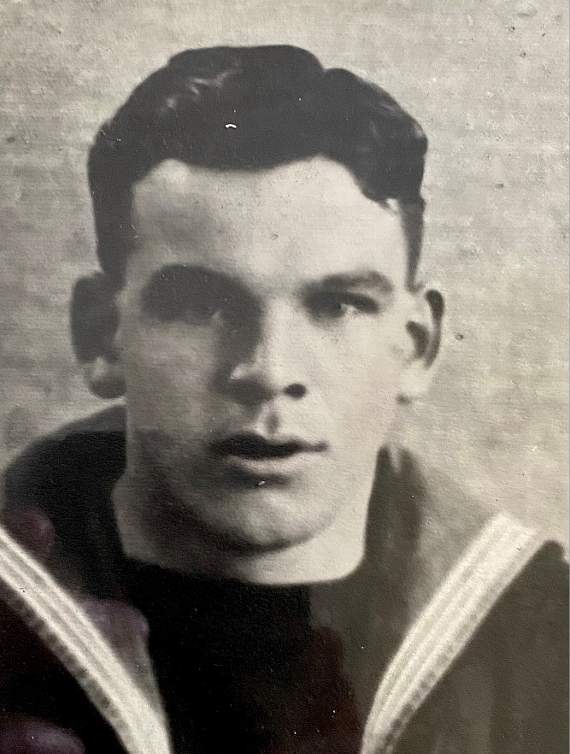
In 1941, a young sailor from Menheniot was among almost 470 men who perished when their ship, the HMS Galatea, was torpedoed off the coast of Egypt.
John Higman was 21 years old.
Vivian Harvey is John Higman’s nephew, and he shared the story of his uncle with a fellow Menheniot resident John Marriott, after learning that John had been an naval officer in the submarine service.
John Marriott says he was very moved by the story of the young man’s death in the “wine-dark sea” of Homer’s Iliad, and with Vivian Harvey’s help, he pieced together more about the HMS Galatea and about the Higman family in Menheniot.




He says: “John died a long way from home at the age of 21 years. Many of the crew of the ship hailed from Devon and Cornwall.
“I decided to raise a tribute to the memory of John, and his shipmates of the Galatea who died beneath the waters of the Mediterranean Sea.”
I never knew John Francis Higman: how could I? I was one year and three days old when HMS Galatea was sunk by enemy action. However, looking at those faded photographs of the men who were relatives of Vivian’s mother (Dulcie), George, Maurice, and John Higman made me wonder about their lives in Menheniot at the outbreak of war. In their photograph, taken by John H. Coath & Son of 20 Fore Street, Liskeard, Maurice and his wife Doris look decidedly uncomfortable in their Sunday best, their slightly nervous expressions betraying something of their characters. Surprisingly, I became increasingly emotionally involved with them. I also found a patriotic Christmas card written by Maurice whilst serving in HMS Decoy to George and Flo. The card included a photograph of HMS Decoy, a?D-class?destroyer ordered for the Royal Navy in 1931, and entered naval service in 1933.?The photograph of this greyhound of the Fleet seemed strangely constrained within the faded, folded piece of card that held it. The front page of the beige card was elevated by a patriotic motif consisting of a red, white and blue ribbon that partially enfolded the left-hand side of the photograph of Decoy. Whilst towards the foot of the front page, the words ‘Christmas Greetings’ provided a clue as to the card’s intended purpose, reflecting Christ’s subordinate role to the Gods of war.
John Francis Higman, Stoker 1st Class, had barely reached the age of 21 years when he lost his life due to enemy action whilst serving aboard HMS Galatea. The ship, under the command of Captain E.W.B. Sim, Royal Navy, sunk after being hit by three torpedoes: two fired by the Kriegsmaine’s submarine U-557, the third by the Italian submarine Dagabur?(Torri) at about 19.55. Within 3 minutes Galatea capsized and sank with massive loss of life, at a point about 35 miles west of Alexandria on 14th December 1941.
HMS Galatea had been returning to Alexandria with a cruiser force of the Mediterranean Fleet following an unsuccessful hunt for an Italian convoy bound for Libya. Captain Sim, 22 officers and 447 ratings were lost. The majority of the fatalities were either trapped below deck or sucked down by the Galatea on her final journey to the Deep Six: the same wine-dark sea where numerous Greeks, Persians and Romans had died more than two thousand years earlier, during Ancient Greece’s many wars with the Persian Kings Darius and Xerxes. One of Galatea’s dead was John Francis Higman. 144 survivors were picked up by HMS Griffin under the command of Captain H.St.L. Nicholson, DSO, RN, and HMS Hotspur under the command of Lieutenant T.D. Herrick, DSC, RN.
Did John Higman, a young man who stood on the threshold of adulthood, leave a girlfriend behind in Menheniot? Was his memory entwined within the affection of a young faithful heart in the Parish of Menheniot? Although death sought out John, beneath the waters of the wine-dark sea, so far away from the Cornish fields and lanes that surrounded his village; the awful news of his death arrived by letter all too soon, to parents ill-prepared and unwilling to receive it. Having given birth to him twenty-one years earlier, his mother, always proud of her John, required no image to remember him. However, she retained a photograph that slowly faded over time within a silver frame that stood on the sideboard or mantle shelf. It showed a proud young man in naval uniform taken immediately before his ship left Devonport for the last time. That image, preserved by his loving mother, was at her death, passed on to the family in memory of a loving son. With the passing of time, young John may have become almost a stranger to later generations of Higmans. He had become forever enclosed within the confines of that silver frame: his photograph a slowly fading, crinkled, sepia image of the young man who once shone with life upon his parent’s mantle shelf. That photograph, aged and maybe later consigned to a draw or a box in the attic, was never large enough to contain his soul. After the war, John’s name was added to the names of the village’s fallen, recorded on the War Memorial that sits astride the roads that divide the village just opposite the Parish Church. Each year large numbers, old and young, assemble around the War Memorial to remember the sacrifices made by members of their community.
With the luxury of distance, we may console ourselves that the nation eventually overcame the Axis Powers: however, the price of victory was terribly high. The U-557, the submarine that sunk the Galatea was, in her turn, rammed and sunk by the Italian torpedo boat Orione less than 48 hours later with the loss of all hands. The crew members who perished in both ships did so because allied politicians at Versailles, twenty years earlier, desiring to revenge themselves on Germany for WW1, financially and militarily, set light to a slowly burning fuse that led to the rise of Hitler, the deaths of twenty million Russians, six million European Jews and millions more. It could well have been the material for a tragedy by Aeschylus. John Higman and his ship mates that died on that fateful evening in December 1941, together with the entire crew of U-557, demonstrated, if a demonstration were needed, the futility of war. I am sure that rather than helping to propel Galatea through the wine-dark seas of Homeric legend, young Johnny Higman longed to return to the green fields of Menheniot, his friends and, above all, his family.