

In this week’s Nature Watch, photographer Ray Robert’s departs from his local surrounds for a walk on the edge of Bodmin Moor.
I couldn’t resist driving up to Minions and having another walk on the moor. The car park was nearly full and there were lots of people on the moorland and I thought, what better place is there for a family to bring a picnic and spend the day discovering the pools, ponds and paths that have been here for hundreds of years and are overlooked by that pile of stones called the Cheesewring.
The grass is strewn with the tiny yellow blooms, about 10mm wide, of the tormentil – Potentilla erecta – plants that spread across heaths and moorland and flower in groups. During the 1600s a powder made from tormentil root was used to appease the rage of toothache and a local name for the plant was ‘blood root’ as a red dye was extracted from the roots to colour clothing.
Another tiny flower, this one only about 8mm wide, is eyebright – Euphrasia officinalis – which was also in bloom for my visit. This plant favours the grassy banks and during the Middle Ages the yellow and purple colouring on the flower were thought to resemble a bruised eye, so eyebright became its common name.



What can be said about all the gorse bushes that brighten up the moor with their glorious yellow flowers that open in May and, if you are brave enough to get close and smell them, might remind one of desiccated coconut. Some of the flowers are turning brown now and oddly enough, gorse, or furze as it is also known, is a member of the pea family.
Several of the hawthorn trees, and there are many on the moor, lean to the north east due to the prevailing south westerly wind and on one of them there was some lichen that looked like an old man’s beard. I think it was the Usnea lichen that branches out into hair-like tangles.
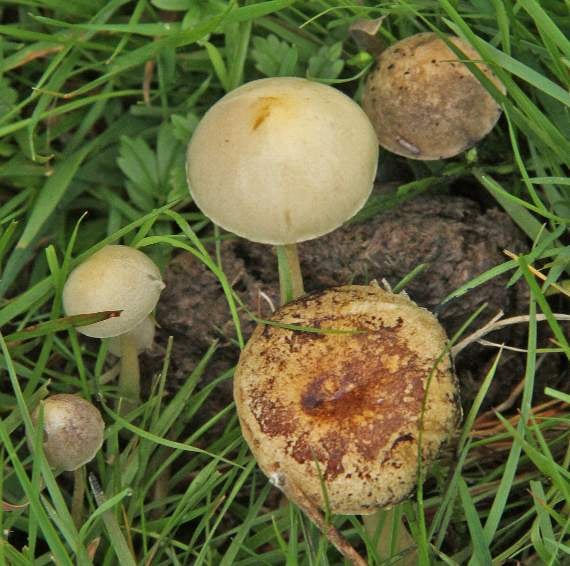
On my last visit there were several belted Galloways to be seen but none were near the village today. Even so, there was evidence of the Galloways as there were several dung roundhead mushrooms that grow on cow-pats. Also, there were lots of spear thistles – Cirsium vulgare – that were growing up to a metre high. I don’t think any of the moorland animals touch these prickly vegetables.
Don’t forget, the Rillaton gold cup was found near Minions in 1837, so keep your eyes open as you walk as there may be another cup to be found. It is recorded that workmen were collecting building stone and came across a tunnel that contained some ancient relics including the cup, which is now in the British Museum. A replica can be seen in the museum at Truro although, in my opinion, it should be displayed in Liskeard Museum being of interest to locals and visitors alike. Liskeard Town Council please take note.