
EACH week, hundreds of planning applications come before Cornwall Council’s planning department, seeking to win approval for various plans right across the Duchy.
These plans can comprise of a number of different reasonings– ranging from permission to replace windows or listed building consent ranging up to large house building developments or changing of use of a building, for instance, from an office to a café, or flats.
Within this large and often complex system, there are a number of formats from which planning advice and approval can be sought.
These range from full applications where all the details which comprise a proposed development or work to a building are submitted, to outline applications, where further details are yet to be confirmed, for example, an outline application with reserved matters for appearance may not confirm the final proposed development but rather seek permission in principle.



National-Trust-Images_John-Millar.jpeg?width=209&height=140&crop=209:145,smart&quality=75)
An example of this is one for an outline permission for 20 dwellings on land with reserved matters for appearance and scale; the reserved matters would require further permission later for their inclusion.
Other types of applications include pre-application advice requests, where would-be developers submit often outline proposals to a local authority to ascertain whether it is likely to gain support or not prior to submitting a planning application.
The vast majority of applications are decided by planning officers employed by a local authority under ‘delegated powers’, meaning they do so on behalf of their employer, however, some applications are ‘called in’ by local councillors to be discussed at an area’s strategic planning committee meeting, meaning the final decision rests with a committee of councillors.
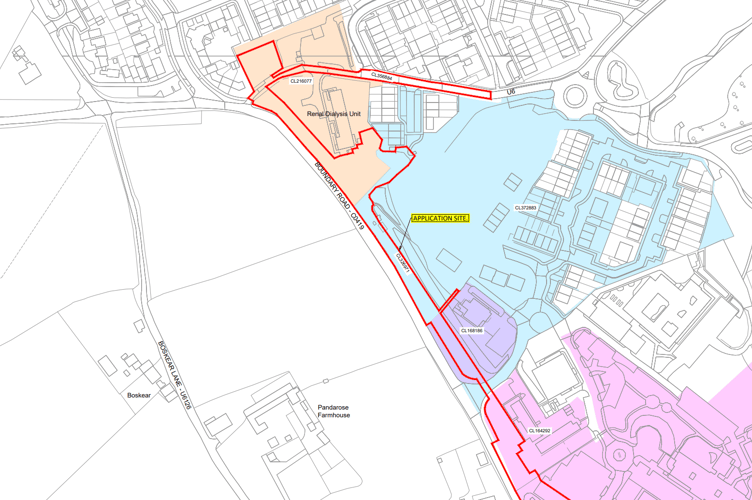
New cycle path for Bodmin
Cormac Solutions Ltd has applied to Cornwall Council seeking its opinions on the proposals to construct the shared use path next to some of the estates comprising an urban expansion of the town.
A pre-application advice enquiry details the proposals of the applicant and seeks Cornwall Council’s view on whether it is likely to gain officer support and what would be required to achieve it.
The applicant told Cornwall Council: “The proposal seeks to deliver a safe, accessible and sustainable walking and cycling route connecting residential developments on the western edge of Bodmin: Wain Homes (to the north), Treveth (to the east), and Coastline (to the south).
“The scheme supports Cornwall Council’s wider objectives of promoting active travel, reducing car dependency and meeting biodiversity net gain targets.
“The new Treveth housing development to the east will deliver 175 residential dwellings the Coastline housing development to the south delivered 71 residential dwellings in November and the Wain Homes housing development to the north delivered 235 residential dwellings in several phases in approximately 2021.
“At present, there is no continuous, safe pedestrian or cycle connection between the three housing sites and Boundary Road, resulting in increased reliance on private car travel for short journeys to local facilities, schools and employment areas.
“The proposed link will promote active travel and healthier lifestyles in line with national and local objectives, reduce car dependency and associated congestion on Boundary Road and provide a direct, safe route for existing and future residents.
“It will also support sustainable transport infrastructure required by the St Lawrence Urban Extension masterplan and deliver biodiversity net gain and tree canopy targets through sensitive design.
“Without this link, the full sustainable transport benefits of the allocated housing growth will not be realised.”
The application can be viewed using reference PA26/00529/PREAPP.
Par housing plans
AN application seeking Cornwall Council’s views on the principle of building up to three houses on land near Par has been submitted for the planning departments verdict.
Mrs Potts has applied to the local planning authority detailing her proposals to build up to three houses on land she owns.
In documents submitted by her planning agent, Mrs Potts stated: The site is a parcel of land at Kilhallon, Par, currently part of larger field, with the application site enclosed on both sides by residential development. Access is via the classified road U6142. The site is within flood zone one.”
In this application, she is seeking to build a minimum of one dwelling and a maximum of three on the land.
A permission in principle consent route is an alternative way of obtaining planning permission for housing-led development which separates the consideration of matters of principle for proposed development from the technical detail of the development.
The permission in principle consent route has two stages: the first stage (or permission in principle stage) establishes whether a site is suitable in-principle and the second (‘technical details consent’) stage is when the detailed development proposals are assessed.
The applicant told Cornwall Council: “The size of the site allows for the delivery of between one and three dwellings, each with well-proportioned private garden amenity space. This level of development reflects the prevailing residential density within the surrounding area, and in not over-development.
“As the site lies within the settlement of Kilhallon, a lower density is appropriate and responds to the character of the area and on-site constraints such as including appropriate privacy distances, and the retention of mature landscaping.
“This approach ensures that the proposed development respects and reinforces the established character of the locality. Residential development is present on both sides of the site, and the proposal would not result in the encroachment of built form into the open countryside.
“The site is well related to the existing urban form and extent of the settlement and reflects the broad characteristics of the surrounding area. The proposed development would be viewed in the context of existing dwellings to the east, south, and west, ensuring a cohesive relationship with the established built environment.
“As such, the proposal would not represent an outward expansion into the countryside but rather a modest, well-integrated form of development that is appropriately scaled and accessible. Consequently, the proposal would not result in a significant adverse impact on the landscape character of the wider area. All housing will comply with the requirements of National Space Standards (NSS).”
The application can be viewed using reference PA26/03106.
Brewery plans
AN application seeking planning permission for the change of use of a storage building into a brewery on land near Lanivet has been submitted to Cornwall Council.
The application was made by the Harbour Brewing Company Limited and concerns a building on land at Tretoil Farm, Lanivet, Bodmin.
While initially constructed for use as a storage building after planning permission was granted in 2017, the applicant has more recently used it as a brewery.
They told the council: “Planning permission was granted in June 2017 for the storage building at the application site (Cornwall Council ref: PA17/02485) and the building has been occupied by the applicant since. However, the use of the building is now primarily as a brewery and not for storage purposes. Therefore, this application seeks to regularise its use so that the applicant can continue to lawfully operate from the application site.”
The application can be viewed using reference PA26/02196.
Find out about planning applications that affect you by visiting the Public Notice Portal.
Comments
We've recently changed our login process. If you have an account for commenting, you will need to re-register on the login window.
This article has no comments yet. Be the first to leave a comment.