
EACH week, hundreds of planning applications come before Cornwall Council’s planning department, seeking to win approval for various plans right across the Duchy.
These plans can comprise of a number of different reasonings – ranging from permission to replace windows or listed building consent ranging up to large house building developments or changing of use of a building, for instance, from an office to a café, or flats.
Within this large and often complex system, there are a number of formats from which planning advice and approval can be sought.
These range from full applications where all the details which comprise a proposed development or work to a building are submitted, to outline applications, where further details are yet to be confirmed, for example, an outline application with reserved matters for appearance may not confirm the final proposed development but rather seek permission in principle.
.png?width=209&height=140&crop=209:145,smart&quality=75)
An example of this is one for an outline permission for 20 dwellings on land with reserved matters for appearance and scale; the reserved matters would require further permission later for their inclusion.
Other types of applications include pre-application advice requests, where would-be developers submit often outline proposals to a local authority to ascertain whether it is likely to gain support or not prior to submitting a planning application.
The vast majority of applications are decided by planning officers employed by a local authority under ‘delegated powers’, meaning they do so on behalf of their employer, however, some applications are ‘called in’ by local councillors to be discussed at an area’s strategic planning committee meeting, meaning the final decision rests with a committee of councillors.
Former funeral directors premises conversion
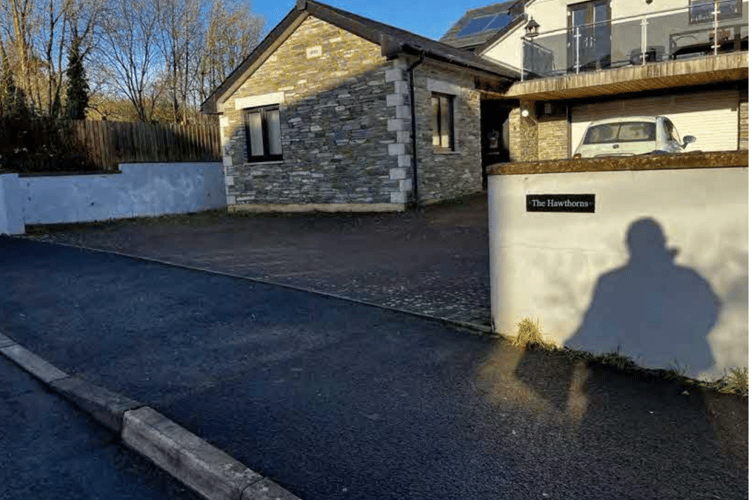
A GROUND floor of a property which was used as the site of a funeral directors premises is set to be converted to residential accommodation after a change of use application was approved by Cornwall Council.
The property at The Hawthrorns on St John’s Road was previously used as the premises of J Weekes Funeral Directors – which closed in early 2025.
The applicant told Cornwall Council: “This proposal seeks planning permission for ‘Change of Use’, from Commercial use to Residential use, of ground floor premises, following the recent closure of J Weekes Funeral Directors, which was established in 1943 and since then has been run by the same local family.
“This proposal seeks Planning Permission for ‘Change of Use ‘of former Funeral Directors ground floor premises to residential use to be incorporated with existing first floor residential premises.”
Cornwall Council issued a condition of approval, stating: “The dwelling hereby permitted shall not be occupied otherwise than by persons as their Only or Principal Home. For the avoidance of doubt the dwelling shall not be occupied as second homes or holiday letting accommodation.
“The occupants will supply to the Local Planning Authority (within 14 days of the Local Planning Authority's written request to do so) such information as the Authority may reasonably require in order to determine whether this condition is being complied with.
“Reason: To safeguard the sustainability of the settlements in the Rame Neighbourhood Development Plan area, whose communities are being eroded through the amount of properties which are not occupied on a permanent basis.”
Trago owner bids to convert barn
THE owner of Trago Mills has submitted their latest bid to convert the largest of three barns into residential units at a location near Bodmin.
Trago Mills Ltd is seeking to use prior approval for the conversion of a barn into eight residential units on land to the South West of Higher Carblake Farm, in Cardinham. It is near to the section of the A30 which was dualled in the last decade.
A prior approval application is a streamlined planning process in the UK where specific permitted developments do not need full planning permission but require approval from the local planning authority (LPA) regarding specific impacts.
One of those types of development that does not always need full planning permission is where an agricultural building is converted into dwellings – in such a way that such buildings are constructed within the footprint of the remaining agricultural building.
In 2025, the applicant was told by Cornwall Council that its proposals to convert the barn into 10 dwellings could not be done without a full planning application as it had concerns over the impact on access to the property that would be incurred through the traffic generated from occupants of the ten houses.
In response, in the latest application, once again seeking to obtain prior approval consent as opposed to a planning application, the latest plans would see a reduction in the number of proposed houses from the previous ten to eight.
The applicant told Cornwall Council: “The Site consists of the largest of three barns just north of the nearest farm dwelling. The overall exterior footprint of the Barn is 590m2. It has access to the road on its east and a Farm Track to the west.
“The existing building is of steel-framed portal construction with a height from the internal floor to a ridge of seven metres allowing for the creation of a full second storey on a new mezzanine. Concrete Block forms the lower walls of the building, while the upper walls and roof are of fibre cement and steel cladding. The use of the barn for livestock has ended, and now it is disused.
“Its previous use was for the farming of deer, and some of the internal pens for this use are present in the building. An adjacent Timber Lean-to barn of 328 metre square footprint will be removed to create amenity and parking for the proposed houses.
“The Barn was subject to a previous prior approval application PA25/02294, but this was refused on access grounds. It is hoped that the revised scheme and traffic and access report will resolve these past concerns, and the proposal can now be supported.”
In the application, Trago Mills Ltd also detailed what it intended to do with the buildings if it was granted permission, continuing: “The proposal seeks to convert the Barn into 8 houses with associated amenities and aims to create a mixed cluster of different-sized dwellings to provide much-needed varied housing stock.
“The eight properties are arranged to work best within the existing structure of the barn, the layout of the farm, and the existing access. Parking provision exceeding the council's minimum requirements is proposed within the development, along with dedicated outdoor spaces for each dwelling.
“The houses are designed to allow maximum flexibility and provide opportunities for multigenerational cohabitation and growing families. Proposed Materials have been considered to reflect the Agricultural nature of the building while being visually appealing and low maintenance for future owners and occupiers.
“New insulated floors will be required throughout on both the concrete and earthen floors. It is proposed that a structural screed containing radiant under-floor heating be installed on top of the insulation. This would be possible with minimal interventions to the existing well-compacted or concreted existing floors. Foundations do not show signs of subsidence and appear to be of good size.”
Find out about planning applications that affect you by visiting the Public Notice Portal.
The full proposals can be viewed on the Cornwall Council planning portal using reference PA26/02723.
Comments
This article has no comments yet. Be the first to leave a comment.