
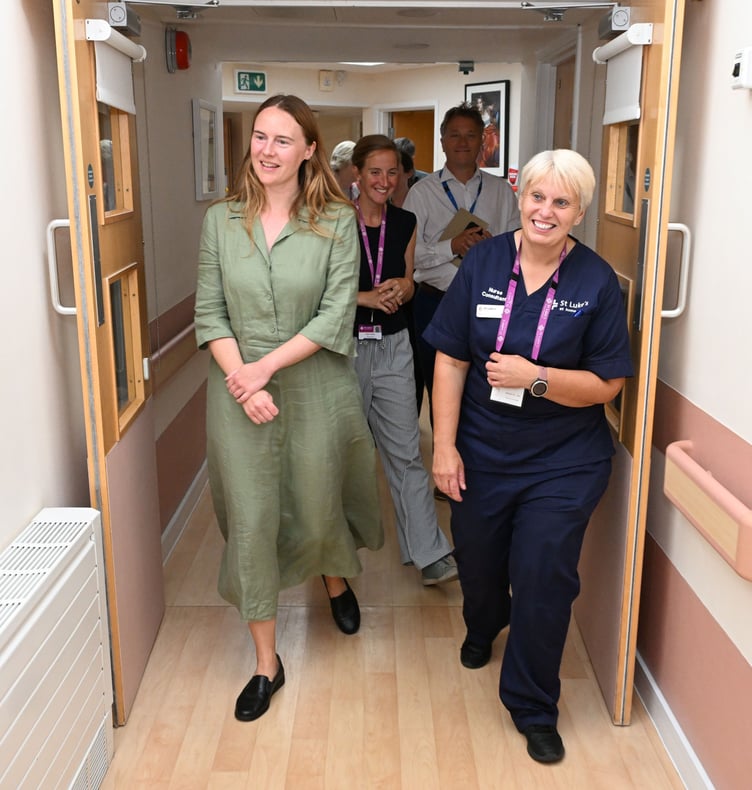
THE MP for South East Cornwall has called for better end-of-life care for families in her constituency after hearing how the Tamar can become a barrier to accessing support.
Anna Gelderd made her first visit to St Luke’s hospice in Plymouth, where she met clinical leaders, frontline staff and trustees to discuss the challenges facing people with life-limiting illnesses.
Drawing on her own experience of caring for her mother through terminal cancer, she heard how patients in Saltash, Torpoint, Callington, Pensilva, St Germans, the Rame Peninsula and rural communities can face different levels of support depending on where they live.
The meeting focused on why Cornish residents should not have access to fewer options than people receiving care in Devon.
Ms Gelderd said: “You cannot put a price on what you do to support people I represent in South East Cornwall and their families. I know that there’s still much progress to be made and I’ll continue to listen to the challenges affecting essential services.”
St Luke’s said its East Cornwall Urgent Care Pilot, funded through charitable income, supported patients and families across a large part of the constituency during 2024 and 2025.
Clinical operations lead Jen Nicholls explained how rapid intervention can help patients return home from Derriford Hospital and remain there as their needs change.
“When we get a call from the hospital, we can turn a discharge around in one day, often the same day,” she said. “We meet and greet them at Derriford so they know who will be there for them at home when they come out of hospital. And if someone’s needs change, we can scale our care up or down to accommodate that.
“The team do an amazing job. It is not just a package of care. They hold the whole family and support them at the most difficult time of their lives.”
Dr Doug Hooper, consultant in palliative medicine at University Hospitals Plymouth, said around a quarter of patients treated at Derriford live in Cornwall. But he warned accessing community support can become more difficult once those patients are ready to leave hospital.




“The Tamar seems to act as a massive wall,” he said. “In the last weeks of life, care is funded differently and we can make a clinical judgment to access that funding. On the Devon side of the border we have an arrangement with the Urgent Care Service at St Luke’s. But in South East Cornwall we regularly have people who don’t get funding in time and die in hospital.”
St Luke’s is seeking a community end-of-life care contract covering South East Cornwall, alongside five-year NHS contracts for core hospice services.
Ms Gelderd pledged her support, saying: “I will continue to work hard to support St Luke’s, so that the team have the resources they need to support patients and families.”
After touring the hospice and meeting staff, she reflected on her own experience of navigating care for her mother.
“I have been that distressed family member on the end of the phone,” she said.
Comments
We've recently changed our login process. If you have an account for commenting, you will need to re-register on the login window.
This article has no comments yet. Be the first to leave a comment.