
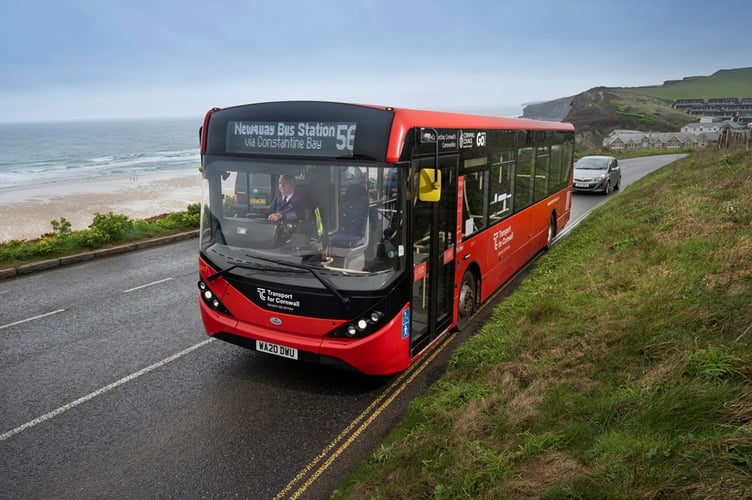
CORNWALL Council has heard that local bus services could change in the future following a franchising and bus reform pilot study, which has resulted in several different models of how the network could operate.
However, councillors have asked if the local authority can actually afford to change to a different system.
A meeting of the council’s sustainable growth committee this week discussed the study and the suggestions for operating the bus network across Cornwall in the future, which range from sticking with the current set-up – the council is in contract with Go Cornwall and subsidises more than half the network for £12-million a year – to fully operating bus services itself and purchasing the fleet and depots.
Councillors heard that Cornwall Council is increasingly reliant on public funding. The commercial instability caused by First Bus withdrawing from Cornwall in February didn’t help the situation, leaving half of the county without bus services.
However, Cornwall is now back to having almost full coverage.
The Department for Transport (DfT) gave Cornwall Council just under half-a-million pounds to fund a franchising and bus reform pilot study testing different models of bus services.
The study found that the “best case scenario” for Cornwall Council would be an Enhanced Partnership Plus (EP Plus) scheme, which could provide the council with greater influence over the planning of the commercial network and fares – currently two areas outside the remit of local authorities.
Peter Hardy, who worked on the pilot study, said: “The ‘best scoring’ was the EP Plus model, so for every £1 spent, it should have £4.19 of benefits. In terms of a 30-year full process, the EP Plus is showing £41-million of value.”
However, the direct cost to the council for implementation over the first two years of that model would be £6-million.
If the council was to go the whole hog and buy Cornwall’s bus depots and bus fleet, it would lead to costs of more than £150-million in its first two years.


The DfT has supplied an additional £1.06-million for Cornwall to carry out a further full franchising assessment, which would determine whether franchising represents the most suitable model. The committee agreed to support the full assessment.
Cllr Peter Channon asked: “What can we actually afford?”
Rebecca Riley, head of strategic transport, replied: “That’s the question. It depends on which basket the council wants to put its eggs into in terms of its budget.”
Committee chairman Cllr Connor Donnithorne said: “If we’re struggling to afford what we currently do, what can we afford moving forward? Let’s be realistic – we have a Prime Minister now who is very keen on buses. He’s very keen on urban models of public transport, which doesn’t necessarily fit into rural models. But that could change and lead to long-term funding.”
“Working with stakeholders and companies means we are best placed to respond to opportunities that arise,” replied cabinet member for transport Cllr Dan Rogerson, who suggested exploring the Enhanced Partnership Plus model.
Cllr Andrew Mitchell added: “I think we’ll always end up having to subsidise buses.
I really support the start of the statutory process. Those questions about what can we afford and who’s going to pay for it will actually all come out of that process.”
Comments
We've recently changed our login process. If you have an account for commenting, you will need to re-register on the login window.
This article has no comments yet. Be the first to leave a comment.