

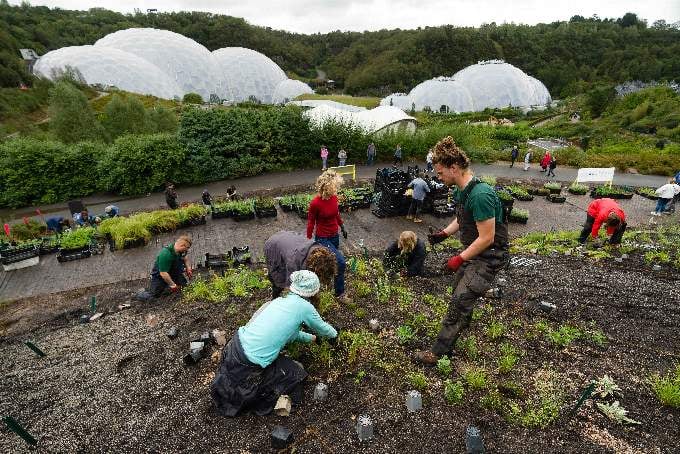
Work begins planting living artworks across the globe, as artist Alexandra Daisy Ginsberg asks us to view the world through the eyes of a pollinator.
Pollinator Pathmaker, a new permanent 55-metre-long living artwork by Alexandra Daisy Ginsberg that explores the vital role of pollinators, will be planted at the Eden Project, Cornwall, this Autumn.
"I hope we can create the largest ever climate positive artwork together, by planting living artworks for pollinators around the world", said Alexandra Daisy Ginsberg on the occasion of the launch and planting.
The artwork is part of the “Create a Buzz” programme at Eden Project, supported by the Garfield Weston Foundation, that seeks to communicate the story of the UK’s native pollinators: their vital role, their current plight and their restoration.




The work has been originally commissioned by the Eden Project and funded by Garfield Weston Foundation. Additional founding supporters are Gaia Art Foundation and collaborators Google Arts & Culture.
Further ‘editioned’ gardens will then be sown across the UK and Europe, following the planting of the inaugural artwork in Cornwall.
Pollinator Pathmaker asks visitors to view the world in a different way; from the perspective of plants and pollinators, and to take part in an international cultural campaign to help save bees and other endangered species of pollinating insects ? the first of its kind. There has been a dramatic decline in pollinating insects in the last 40 years due to habitat loss, pesticides, invasive species, and climate change and the artwork is a call to take action against this.
The living artwork at the Eden Project will comprise a new garden, designed, planted and optimised for pollinators’ tastes, using a specially designed algorithm and specially curated palette of plants.
Green-fingered audiences can also be part of this unique artwork and create, plant and share their own garden and planting scheme, designed for bees and other insect pollinators, using the new website and algorithm at pollinator.art, an experiment developed in collaboration with the Google Arts and Culture Lab. It is hoped people will grow these in whatever space they have available - at home, fields, community gardens and more.
The website launches on 3 November 2021, coinciding with the United Nations Climate Change Conference.
The Cornwall garden is anticipated to be in full bloom for both pollinators and human audiences to enjoy by June 2022.