

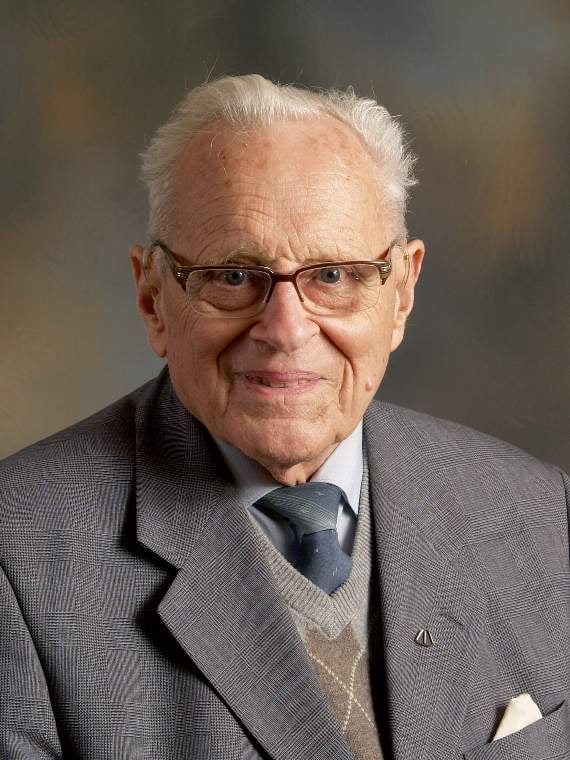
Photographer, historian and archivist John Rapson was one of Liskeard’s most respected elders.
John died on November 11 at the age of 97.
Born in 1923 to one of the town’s long established families, John’s long career began when, as a wireless operator serving in the RAF during the Second World War, he acquired a Zeiss camera.
He ran his photography studio in Liskeard for four decades from 1947 to 1987, capturing some 2,000 local weddings as well as countless family portraits. He also began a dedicated commitment not only to capturing contemporary events as they happened, but also to conserving the town’s history: he was the longest serving member of the Liskeard Old Cornwall Society, founding its archives, and also gave many years of service to the Liskeard and District Museum.

Made a Bard of the Cornish Gorsedh in 1974, his bardic name, Covathor Derevyans, signified “Recorder of Buildings”, and he was made an honoured burgess of Liskeard in 1999 for his huge and varied contribution to life in the town.
With almost ten decades of life in Liskeard, and the conviction that preserving a record of important events, people and places was one of the most valuable things he could do for future generations, John amassed a collection of thousands of photographs, and an equally deep knowledge of the changes in the town over the course of the 20th century, leading him to be the “go-to” person for anyone with questions on local history and happenings.
Diligent and meticulous in his record keeping, he was kind and generous in the passing on of his knowledge to others. His collection of negatives and records have been gifted to the Liskeard and District Museum.
Aside from the war years, John lived his whole life in Liskeard, although he was a keen traveller in his early years, taking trips across Europe by motorcycle, and once he could afford it, by motor car, taking photographs all along the way.
Surfing, preferably with an old- fashioned wooden board, was a passion he enjoyed right up into his late 80s. In his early 90s he moved to Kilmar House, where, says his close friend David Hambly, the wonderful staff made a home for him in his last years.
John, who leaves his sister Molly, died on November 11. A private family funeral is to be held next week: it is hoped that a full memorial service can be held in 2021.
Here, we publish part of John Rapson’s life story, written in his own words in 2009.
“My education started at Highwood House School, then on to the Liskeard Secondary School, later the Grammar School. I left school and started in the butchery business with father. When war was declared, and when it had been set up, I joined the ARP, becoming a messenger boy. I joined the RAF VR and was called up in January 1942, trained as a Wireless Operator (ground). Later, I was also trained as a driver of heavy goods lorries, and I did drive a large lorry off the American tank landing craft on to the Normandy Beach on D-Day plus 12.
“We moved forward across Europe (still driving the lorry) and passing through Brussels soon after Liberation Day where we had an amazing reception, meeting up with a family who were very kind to me. We ended up in Kiel for the surrender. When hostilities ceased, I was in Germany for some months and joined a photographic club (was also driving officers around Germany in a captured Mercedes car).
“With help from Mayor Huddy and The MP I obtained a compassionate release, and returned to the business in Liskeard, where Mum and Dad were feeling the strain of the war years and rationing. Meat was rationed, and supplies were short, so I started up taking photographs.
Grew
“I rented the Coath Studios in Fore Street for a while, and in 1952 opened the shop in Windsor Place, with a studio on the first floor and dark rooms on the ground floor. In the early days, I divided my time between the two businesses. I was usually involved in the Christmas Trade to make sure all had good supplies of the best turkeys, ducks and chicken.
“After father’s death in early 1958, I employed managers to run the butchers, and concentrated on the photographic business.
“This grew and grew, and after my 40 years I totted up that I had photographed over 2,000 weddings. Often I was employing 10 or 12 people and I always employed young people, all of whom seem to have gone on to become useful citizens, and prospered. David Hambly took over the business when I retired in 1987, having built his own shop to house it.
“A lifelong Methodist, I was Chapel Steward for some years, and much enjoyed that activity. I served on the old Trust for over 50 years, as did great grandfather, grandfather and father; later it became the Property Committee.
“I started the Liskeard Gramophone Society (Liskeard Arts Council) in the early 1950s, this was held in the old Congregational Hall. It ceased as radio and television developed.
“I was made a Bard of the Cornish Gorsedd in 1974 for my work recording the buildings of Liskeard – I only missed one Gorsedd in the 30 years to 2004.
“After inheriting it, for over 20 years I ran The Llanbedr Camp Site at Polzeath which involved quite a lot of work, but much enjoyed the walks and surfing with the old-style small boards.
“I have been interested in local history, and a member of many societies: Liskeard Old Cornwall, The Cornwall Archaeological Society, The Trevithick Society, The Local Historians, the Royal Cornwall Institution and Museum in Truro, the Cornwall Heritage Trust, the Sylvanus Trevail Society, the Cornwall Methodist Historical Association and the Stuart House Trust.
“I have been kept busy in retirement dealing with families looking for their roots in the Liskeard area. I have been a co-opted member of the Liskeard Town Council Museum Sub-Committee, having served on it for over 20 years. I was interested in the West Street Museum, and after I became computer literate, I listed all the contents on a database, also the photographs. This proved useful when the new museum applied for registration.
“I was honoured by the town when I was made an Honoured Burgess in 1999, and much enjoyed attending the various civic functions. The internet, another new facility for me, has proved useful, as has e-mail, making quick contact with family and enquirers in far parts of the world.
“In 2005, I ventured into the sea at Polzeath in a wetsuit to do a bit of surfing with one of the new plastic boards, but still prefer the wooden ones we had as children.”