

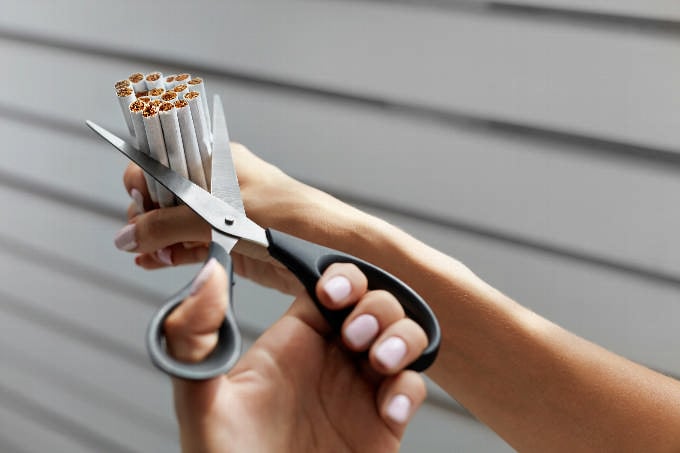
AT this time when many will be deciding on New Year’s resolutions for the coming year 2022, the Government has launched a campaign which highlights the link between parents smoking and children picking the habit up in later life.
Top medical experts have warned that teens whose parents or caregivers smoke are four times as likely to have taken up smoking as those whose parents or carers do not smoke.1
Analysis has also shown that early teens whose main caregiver smokes were more than twice as likely to have tried cigarettes (26 per cent vs 11 per cent ) and four times as likely to be a regular smoker (4.9% vs 1.2%).
A new Government Better Health Smoke Free campaign was launched this week as leading family doctors warn of the issues facing the children of smokers – and calling on people to help prevent this trend by quitting in January 2022.
.jpg?width=209&height=140&crop=209:145,smart&quality=75)



In a new film released on Tuesday (December 28), NHS and behavioural health experts discuss the link between adult smoking and the likelihood of children in their household becoming smokers. This includes family GP Dr Nighat Arif, child psychologist Dr Bettina Hohnen, and smoking cessation experts Professor Nick Hopkinson and Dr Anthony Laverty of Imperial College London, who have called on parents, in particular, to give up smoking in the new year in order to set a good example to their children.
Maggie Throup MP, Parliamentary Under Secretary of State and Minister for Vaccines and Public Health, explained why the campaign is being launched now: “We know that many people make a quit attempt in January, and while there are so many good reasons to stop smoking for yourself, we hope that this new campaign - by highlighting the inter-generational smoking link with parents influencing their children - will be the added motivation many need to ditch the cigarettes for good this year.
“With so much help and support available for parents, carers and anyone looking to quit - including the NHS Quit Smoking app, support on Facebook, daily emails and texts, and an online Personal Quit Plan - you won’t be alone in your New Year’s resolution.”
Recent research from NatCen Social Research has also shown that children aged 10-15 were more likely to smoke if either their mother or father currently smoked. Children were also more likely to smoke if either parent had smoked in the past, even if they were not a current smoker.
Professor Mike Wade, Deputy Regional Director of Public Health NHS South West, said: “If you are a smoker, quitting is one of the best things you can do for your health, allowing you to start moving better, breathe more easily and save money. If you can stop smoking for 28 days, you are five times more likely to stay smoke free for good.
“Smoking damages the lungs and airways, making it harder to breathe. Each cigarette fills our lungs with toxins which harm the immune system and leave us more vulnerable to infections. Stopping smoking brings immediate benefits to health, including for people with an existing smoking-related disease, so it’s never too late to quit.
“By stopping smoking, you’ll be protecting the health of your non-smoking friends and family, too. If you want to quit smoking for your family or for your own health this January, Better Health has a range of proven NHS support and advice to help.”
The Better Health campaign gives access to a range of free quitting support and tools including free expert help from local Stop Smoking Services, the NHS Quit Smoking app, Facebook messenger bot, Stoptober Facebook online communities, daily emails and SMS, and an online Personal Quit Plan.
Search “Smoke Free” for free and proven quit smoking tools and advice on different types of support, nicotine replacement therapies (NRT) and e-cigarettes, to help you quit smoking.