

Some years ago, there was a sycamore tree on the front lawn, but I got fed up with raking the grass every day during the autumn when the leaves dropped, so we had it chopped down and later burnt the wood. We built a rockery on the ground above the tree roots and planted flowers in it.
Last week we had a crop of small, pale buff, mushrooms appear which I determined were Fairies’ Bonnets or Trooping Crumble Caps – Coprinus disseminatus - as they are sometimes called. There were approximately 341 of these fungi, so I was told, the biggest of which were no more than 17mm wide.
The next day however, there were twice the number and had completely surrounded the rockery. These mushrooms usually grow on rotten stumps of broad leaf trees or in the nearby soil. Obviously, the mushroom hyphae, or roots, had contact with the sycamore tree roots so we can expect the same, if not more, next autumn.
I was out walking beside the River Seaton when I came across the ruins of what must have been a farm worker’s cottage and in what used to be the garden there was a quince tree with apple-like fruit on its branches. Although they look like apples they are as hard as the branches they grow on and are impossible to eat raw.



Quince trees were often grown in cottage gardens for making jellies or to add flavour to apple pies and are native to the Mediterranean. They were brought over to Britain by, yes, you’ve guessed it, the Romans. Since the seeds are rarely fertile, the tips of the trees lower branches are pegged into the soil causing roots to grow. This new growth is cut off the branch and replanted to form a new tree.
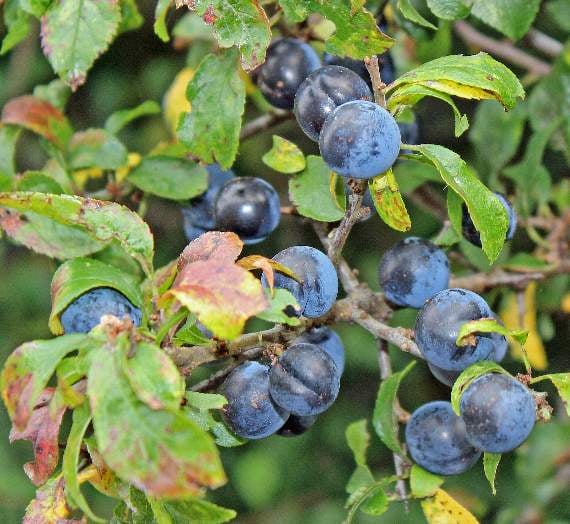
Another fruit that is impossible to eat straight off the tree are sloes on the blackthorn trees. Although they look like small plums, the flesh cannot be eaten as it is too bitter, but they can be used to flavour apple jelly. However, the fruits most popular use is when they are added to gin to produce a colourful sloe gin.
Just when I thought I had seen the last butterflies of the year I came across a red admiral down by the river. A few of these hibernate throughout the winter if they can find an outbuilding near to their feeding spot. Also, beside the river, I spotted a couple of common frogs. One was half grown and the second was quite a large fully grown amphibian. It was on the path and it gave me a look that said ‘Get out of my way!’.
Once again in late October there are a couple of three-cornered leeks – Allium triquetrum – on the roadside near the village oak tree. Their lovely white, bell shaped flowers, maybe ten or so, open at the top of a long three- cornered stem – hence its name. They look a bit like white bluebells but if you plant some in your garden, beware, as they spread and quickly become invasive.