
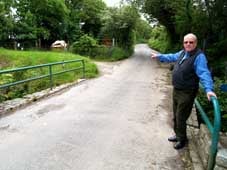
RESIDENTS in a hamlet are challenging Cornwall Council's rejection of their calls for a 30mph speed limit. The residents, who have evidence of cars travelling at up to 60mph, want the speed restriction to be imposed on a narrow lane leading to Siblyback Lake, near Liskeard. They are disputing the figures on which the council's rejection of their calls was based. They say the council decision relied on averaged vehicle speeds, rather than the much higher top speeds. Those living in South Trekeive, near the reservoir, say that increasing numbers of visitors using the lane to access the recreation area and water sports centre are having a huge impact on the quality of their lives. The road is the only access to the lake but is narrow and has sharp bends and virtually no passing places. Residents say their biggest worry is for the safety of the children who live in the hamlet. They say the children can no longer walk up the lane to catch the school bus as it has become too dangerous and the youngsters are now taken to the bus by car. Earlier this year, a site meeting took place involving the local Cornwall Councillor, the police and the council's highways service provider, Cormac Solutions. As a result, resident Peter Lockley was provided with a speed camera with which to record vehicle activity. He told the Cornish Times this week that the device recorded 10,000 vehicles over a three-week period, of which 244 were travelling at between 30 and 60 miles per hour near a terrace of cottages and an old bridge at South Trekeive. But Cornwall Council issued a statement saying the average speed through the hamlet was found to be 21mph. 'The road is a typical narrow rural lane with very few properties,' the statement added. 'In accordance with Cornwall Council's speed management policy, the hamlet itself does not have sufficient continuous development or public facilities to be considered as a village suitable for a 30mph speed limit. 'The council is working with the South West Lakes Trust to consider the provision of additional warning signs and road markings.' Mr Lockley said that the road was originally a track and was only surfaced to provide access when the reservoir was built in 1969. 'We have had cyclists knocked off their bikes, walkers forced to jump into the hedge and cars damaged in collisions – something needs to be done urgently,' he said.
.jpg?width=209&height=140&crop=209:145,smart&quality=75)

Comments
This article has no comments yet. Be the first to leave a comment.