
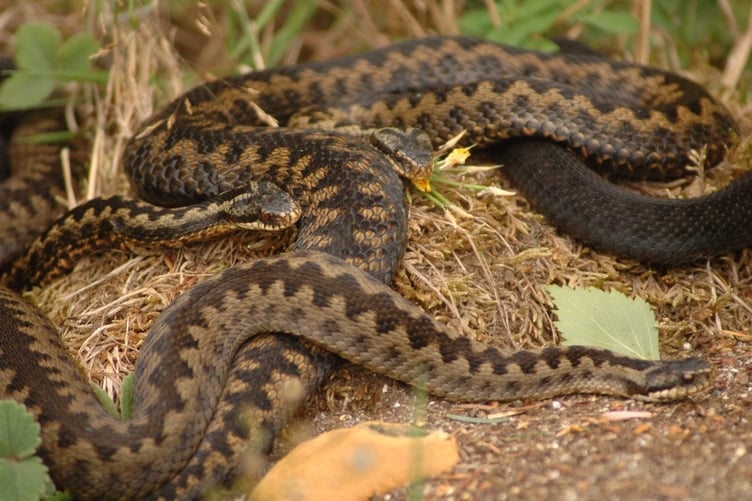
ONE of Cornwall’s most deadliest snakes could be getting a boost thanks to a new collaboration involving the University Centre Cornwall College in Newquay.
The collaboration is focused on investigating the impact of habitat fragmentation on one of the UK’s threatened snakes, the adder.
Reptile and amphibian conservation charity, Froglife has announced that the Newcastle University, Bangor University, University Centre Cornwall College in Newquay, Cornish Adder Project and Natural England will work together on this project.
Habitat fragmentation is having a significant impact on adder populations across England; Dr Emma Gardner from the UK Centre for Ecology and Hydrology (UKCEH) collected data through the Amphibian and Reptile Groups of the UK (ARG UK) ‘Make the Adder Count’ project and found 90 per cent of adder sites surveyed had small populations and on average these populations have less than 10 adders and are in decline.
The project will use Cornwall to explore how natural barriers, such as rivers and farmland, and human-made barriers, such as roads, can isolate adder populations. Cornwall has a 7km land connection between the River Tamar and the sea; a second river barrier isolates adder populations on West Penwith and the A30 separates the county north and south. This project will look at how Cornwall’s rivers and roads have shaped and separated adder populations.
The project will also evaluate the genetics of Cornish adders relative to English populations, involving Citizen Scientists to support adder conservation.
Dr Andy Smart, head of science and research at Froglife, said: “Most people will never see an adder but these beautiful snakes have a key role within our natural ecosystems.

.jpeg?width=209&height=140&crop=209:145,smart&quality=75)


“We will be asking Citizen Scientist volunteers in Cornwall to send in adder sloughs (shed skins) for us to analyse and use our Dragon Finder App to send us records of adder sightings across the county, helping us get an idea of when they are active and where they occur.”
Comments
We've recently changed our login process. If you have an account for commenting, you will need to re-register on the login window.
This article has no comments yet. Be the first to leave a comment.